International Wills in London: A Strategic Guide to Cross-Border Estate Planning (2026)

Updated: Aug 26
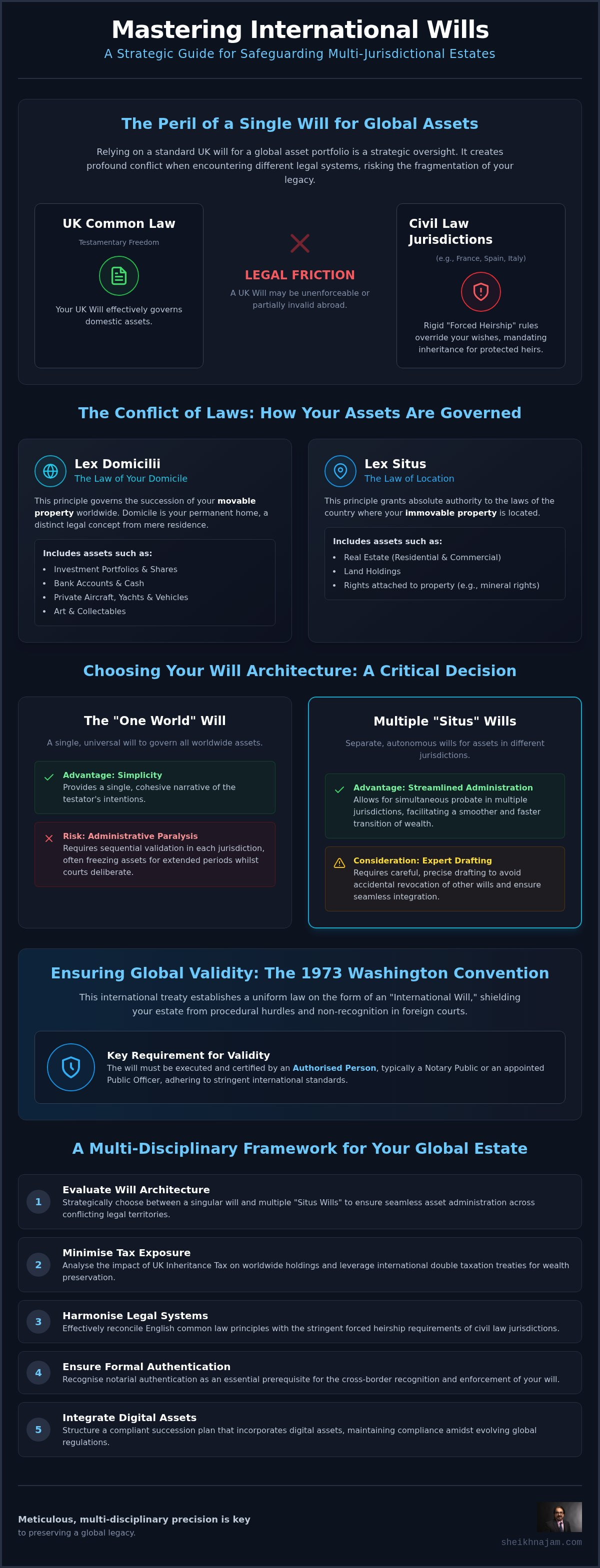
The assumption that a singular testamentary instrument suffices to govern a global asset portfolio is not merely optimistic; it is a profound strategic oversight that risks the total fragmentation of a hard-won legacy. You understand that when wealth transcends borders, the legal complexity doesn't simply increase; it compounds through the collision of disparate legal traditions. The inherent friction between English common law principles and the rigid forced heirship regimes common in civil law jurisdictions creates a volatile landscape for the unprepared. This authoritative guide provides the forensic analysis required to master international wills London professionals deploy to safeguard multi-jurisdictional estates against such systemic risks.
By engaging with this strategic framework, you'll gain the precise insights necessary to minimise international inheritance tax exposure and ensure the absolute validity of your directives in foreign courts. We shall navigate the technical nuances of notarial authentication, the strategic application of the lex situs doctrine, and the integration of digital assets into a robust succession plan. Our objective is the preservation of your global estate, facilitating a seamless transition of wealth to the next generation through meticulous, multi-disciplinary precision.
Table of Contents
Navigating the Complexity of Multi-Jurisdictional Asset Protection
The proliferation of global wealth amongst London’s elite has necessitated a fundamental shift from parochial estate planning to a more sophisticated, multi-jurisdictional jurisprudence. An international will is not a mere template or a standard addendum to a domestic document; it is a bespoke testamentary instrument engineered to survive the friction of competing legal systems. Within the City of London, practitioners frequently encounter the intricate challenges of Private International Law, where the succession of a single estate may be governed by three or more disparate legal codes simultaneously. Standard UK wills, whilst effective for domestic interests, often lack the structural integrity to govern property situated abroad because they fail to account for the doctrine of lex situs.
A primary failure in cross-border planning involves the conflation of residence with domicile. Whilst residence is a matter of physical presence, domicile is a deeper legal concept reflecting an individual's permanent home and intentions. This distinction is the fulcrum upon which international succession turns, as it determines which country's laws will ultimately adjudicate the distribution of your global portfolio. When drafting international wills London clients must ensure their advisors possess the multi-disciplinary expertise to navigate these nuances with absolute precision.
The Conflict of Laws: Lex Domicilii vs Lex Situs
English law maintains a binary approach to succession that often surprises the unprepared testator. The distribution of movable property, such as investment portfolios, cash, or private aircraft, is generally dictated by the lex domicilii. Conversely, immovable property, specifically real estate and land, falls under the absolute authority of the lex situs, the law of the place where the property is situated. This creates significant tension when assets are located in civil law jurisdictions, such as France, Italy, or Spain, where "forced heirship" regimes prevail. These regimes mandate that a specific portion of the estate must pass to "protected heirs," such as children or a spouse, effectively overriding the testator's expressed wishes. Without meticulous structuring, a London-drafted will may be rendered unenforceable in foreign courts, leading to the fragmentation of the legacy.
The 1973 Washington Convention and International Validity
To mitigate the risks of jurisdictional invalidity, practitioners leverage the legal framework established by the 1973 Washington Convention. This treaty provides a uniform law on the form of an "International Will," ensuring that a document executed in London is recognised as valid in all signatory states, irrespective of the location of the assets or the testator's nationality. The requirements for formal validity under this convention are exceptionally stringent. They necessitate the involvement of an authorised person, typically a Notary Public or an appointed Public Officer, to certify the document’s execution. By adhering to these internationally recognised standards, we provide a layer of global security that transcends national borders, shielding the estate from the procedural hurdles that often plague cross-border probate.
The Architecture of International Wills: Single vs Multiple Instruments
The structural design of a global estate requires a decisive choice between two primary testamentary architectures: the "One World Will" or the "Situs Will" strategy. A singular worldwide instrument provides a cohesive narrative of the testator’s intentions, theoretically simplifying the drafting process. However, this simplicity is often illusory. When such a document is presented for probate in multiple jurisdictions, it must undergo sequential validation. This frequently results in administrative paralysis, where assets in one territory remain frozen whilst courts in another deliberate over the original document. For those seeking a more streamlined transition of wealth, the deployment of international wills London experts recommend often involves a more granular approach.
The "Situs Will" strategy involves creating separate, autonomous testamentary documents for specific jurisdictions. This allows for concurrent probate applications, enabling executors to settle affairs in the United Kingdom and foreign territories simultaneously. The primary risk of this approach is the "accidental revocation" trap. Standard English will templates often include a boilerplate clause revoking all previous testamentary dispositions. If not meticulously tailored, an individual executing a new London will may inadvertently nullify a pre-existing French or Spanish instrument, leading to total intestacy in those regions. Precision in the "commencement and revocation" section is therefore a non-negotiable requirement for any sophisticated international succession strategy.
When to Utilise Separate Situs Wills
Separate instruments become essential when dealing with civil law jurisdictions that maintain rigid linguistic and formal requirements. Certain territories mandate that testamentary documents be drafted in the local language or executed before a local notary to be deemed valid. Furthermore, many civil law systems do not recognise the common law concept of a "Trust." Attempting to govern property in such a jurisdiction through a trust-based London will can lead to significant tax penalties or the total failure of the gift. Separate documents allow for the use of local legal vehicles, such as the usufruct, to achieve the testator's objectives within the local regulatory framework.
The Integration of Digital Assets and Global Interests
Modern estate planning must now encompass a "digital situs" that transcends physical borders. High-net-worth individuals often possess multi-jurisdictional digital holdings, ranging from decentralised crypto-assets to proprietary data stored in global cloud infrastructures. The jurisdictional ambiguity of these assets presents a unique challenge for fiduciaries. A robust international will must explicitly grant executors the authority to access, manage, and transfer these digital vaults. Without specific language that accounts for the terms of service of global providers and the privacy laws of various jurisdictions, these assets risk becoming permanently inaccessible, effectively vanishing from the legacy.
Strategic Considerations for London-Based Private Clients
The fiscal exposure of a London-based estate is rarely confined to the domestic borders of the United Kingdom. For testators deemed domiciled within this jurisdiction, the reach of UK Inheritance Tax (IHT) is notoriously expansive, encompassing the entirety of their worldwide asset portfolio. This global tax net, typically levied at a rate of 40% on assets exceeding the applicable thresholds, necessitates a sophisticated application of Double Taxation Treaties (DTTs). These bilateral agreements are the primary mechanism for mitigating the risk of being taxed twice on the same capital. Without the forensic integration of these treaties into international wills London residents risk the substantial erosion of their family wealth through uncoordinated fiscal obligations.
The regulatory environment for non-UK domiciled individuals, colloquially known as "non-doms," has undergone profound transformations leading into 2026. The transition towards a residence-based regime for inheritance tax requires a proactive reappraisal of existing testamentary structures. For these individuals, the distinction between "excluded property" and UK-situs assets remains a critical boundary. Precise drafting must ensure that foreign assets are shielded from the UK tax net whilst ensuring that the transition of domestic wealth remains compliant with the latest statutory mandates. It's a delicate equilibrium that demands a practitioner who operates at the intersection of international tax and private jurisprudence.
Brussels IV and the Choice of Law Election
For London clients with property interests in the European Union, the EU Succession Regulation (Brussels IV) provides a vital strategic tool through the "choice of law" election. Article 22 of the Regulation permits a testator to designate the law of their nationality to govern the succession of their entire estate, including immovable property located in signatory states. This election is particularly powerful for those wishing to circumvent the "forced heirship" rules prevalent in civil law jurisdictions. By explicitly electing English law within their will, a testator can ensure that their testamentary freedom is respected across the Continent. However, the procedural requirements are exacting; any ambiguity in the declaration can lead to the regulation's default rules applying, which typically favour the law of "habitual residence."
Contentious Probate: Pre-empting International Will Disputes
Multi-jurisdictional estates are inherently susceptible to litigation, often triggered by disgruntled heirs leveraging foreign legal codes to challenge a London-drafted will. Identifying high-risk jurisdictions where "clawback" claims are common is a prerequisite for a robust estate plan. To pre-empt these conflicts, we increasingly integrate bespoke mediation and arbitration clauses directly into the testamentary instrument. These provisions mandate that disputes be resolved in a neutral, private forum, avoiding the public and costly theatre of foreign courtrooms. By incorporating a high-value contentious probate London perspective, we can "stress-test" the will against potential challenges, ensuring that the architecture of the estate is as defensible as it is strategic.
The Intersection of Notarial Acts and International Succession
The validity of international wills London residents execute often hinges not on the substance of the bequests, but on the formal rigour of their authentication. Whilst English domestic law is relatively permissive regarding the witnessing of testamentary documents, foreign jurisdictions, particularly those rooted in the Napoleonic Code, require a significantly higher threshold of verification. A Notary Public, acting as an appointed Public Officer by The Court of Faculties, provides the requisite level of institutional weight to these instruments. Their role transcends simple observation; it involves a forensic verification of the testator's identity, a rigorous assessment of testamentary capacity, and a formal certification that the document was executed in accordance with both local and international mandates.
This meticulousness is especially vital when dealing with assets in jurisdictions that don't recognise the principle of "probate" in the same manner as the United Kingdom. In many civil law systems, the notary is a central figure in the succession process, and they will only accept foreign documents that meet their exacting standards of formal validity. By ensuring that the drafting and authentication are handled by a practitioner who possesses the TEP designation, you mitigate the risk of your testamentary intentions being dismissed by foreign registrars on a procedural technicality.
Authentication and Legalisation of Testamentary Documents
There exists a profound distinction between the simple witnessing of a signature and the formal notarial execution required for cross-border efficacy. For a will to be accepted by foreign land registries or financial institutions, it must often undergo the "legalisation" process. This typically involves the attachment of an Apostille, a certificate issued under the 1961 Hague Convention, which verifies the signature and seal of the Notary. This multi-layered process ensures that the document is "fit for purpose" in civil law registries, preventing the administrative delays that occur when foreign officials question the provenance of a UK instrument. The integration of professional notarial services into the estate planning phase is not an optional luxury; it is a fundamental requirement for the secure transmission of global wealth.
Collaborating with Foreign Counsel and Notaries
Executing an international succession strategy requires the seamless coordination of a "chain of authentication" that spans multiple legal systems. The objective is to harmonise the London-based instructions with the specific procedural requirements of foreign counsel and notaries. This collaboration is particularly vital during the translation of testamentary instruments, where linguistic precision is paramount to ensure that technical legal concepts, such as "life interest" or "remainder," are accurately reflected in the target language. Managing these complex interactions requires a master advisor who can command the respect of foreign legal professionals whilst maintaining absolute control over the testator’s overarching strategic objectives. To secure your global legacy through meticulous authentication, you may consult with a specialist in international notarial acts.
Executing a Bespoke International Succession Strategy
The finalisation of a cross-border estate plan is an exercise in multi-disciplinary synthesis, requiring the seamless integration of Inheritance Tax Planning, Trust and Estate Administration, and expert Notarial Services. It's not enough to draft a document that's merely legally sound in the United Kingdom; it must be strategically resilient across every territory where wealth is held. This necessitates a rigorous jurisdictional audit to identify potential conflicts before they manifest as costly litigation. When orchestrating international wills London clients must look beyond the immediate future, establishing ongoing review cycles that account for the volatile nature of global tax regulations and shifting bilateral treaties. The transition of wealth is a dynamic process, not a static event.
One must also consider the management of affairs during the testator's lifetime, particularly in the event of incapacity. A Lasting Power of Attorney (LPA) executed in London may not be automatically recognised by foreign financial institutions or medical authorities in civil law jurisdictions. Ensuring that your fiduciaries possess the requisite authority to act on your behalf internationally requires a coordinated approach, often involving the execution of local equivalents or the formal legalisation of the English instrument for foreign use. This ensures that the control of your global interests remains within your trusted circle, regardless of your physical location or health status.
The Meticulous Drafting Process
The selection of executors is a critical component of mitigating fiduciary risk within a multi-jurisdictional framework. These individuals must possess the professional acumen to manage concurrent probate applications and navigate the complexities of foreign tax filings without jeopardising the estate's overall tax efficiency. Each bespoke testamentary structure is the product of exhaustive jurisprudential inquiry, ensuring that theoretical legal principles are translated into unassailable practical protections. This process moves methodically from the initial audit to the final notarial execution, leaving no room for the procedural ambiguities that often lead to estate fragmentation or the failure of specific bequests.
Securing Your Global Legacy
To maintain the integrity of your international estate, a final review of the following strategic pillars is essential for any high-net-worth individual:
Verification of the "choice of law" election under Brussels IV for all European property interests.
Formal authentication of all testamentary documents by a Notary Public to satisfy foreign registry requirements.
Coordination of multiple Situs Wills to eliminate the risk of accidental revocation of foreign instruments.
Alignment of digital asset structuring with traditional testamentary instructions to prevent asset loss.
The peace of mind afforded by a strategically sound, authenticated estate plan is the ultimate objective of this rigorous process. By entrusting your affairs to a practitioner who holds the TEP designation and serves as an appointed Public Officer, you ensure that your legacy is handled with absolute precision and institutional weight. For those seeking to secure their wealth amidst the complexities of 2026 and beyond, the path forward is one of meticulous preparation and global foresight. Consult with Sheikh Najam TEP regarding your international will requirements to initiate a comprehensive review of your global succession strategy.
Mastering the Global Testamentary Landscape
The successful preservation of a multi-jurisdictional legacy demands more than simple drafting; it requires a forensic harmonisation of English law with the disparate mandates of foreign jurisdictions. You've observed how the strategic deployment of international wills London professionals orchestrate involves a meticulous balance of Situs Will coordination and notarial authentication. By proactively addressing the friction between common law principles and civil law regimes, you ensure that your global assets remain a cohesive legacy rather than a fragmented liability. This level of precision is the only certain safeguard against the administrative paralysis of cross-border probate.
As a TEP qualified practitioner and a Public Officer appointed by The Court of Faculties, Sheikh Najam provides the institutional weight and specialist knowledge in multi-jurisdictional Private International Law required for such complex affairs. Every bespoke strategy is designed to offer absolute certainty in an increasingly volatile regulatory environment. Your global interests deserve the command and control of a master advisor who understands the intersection of international tax and private jurisprudence. Secure your global legacy with expert international will structuring from Sheikh Najam TEP. You can move forward with the confidence that your affairs are handled with absolute precision.
Frequently Asked Questions
What is an international will and do I need one if I live in London?
An international will is a specialised testamentary instrument executed in accordance with the 1973 Washington Convention, designed to ensure formal validity across various signatory jurisdictions. If you reside in London but possess a global asset portfolio, such an instrument is essential to mitigate the procedural hurdles often encountered when domestic documents are presented in foreign courts. It provides a standardised framework for recognition that transcends national borders, ensuring your intentions are respected globally.
Does a UK will cover my property and bank accounts located overseas?
Whilst a standard UK will may technically encompass your worldwide estate, its practical efficacy is frequently undermined by the doctrine of lex situs, particularly regarding immovable property such as foreign real estate. Foreign financial institutions and registries often demand local probate or specific notarial authentication before they'll recognise an English instrument. Relying solely on a domestic document risks administrative paralysis and the potential application of foreign forced heirship regimes that override your wishes.
How many wills should I have if I own assets in multiple countries?
The optimal number of testamentary instruments depends upon a forensic audit of your specific asset locations and the legal traditions governing them. In many instances, the implementation of separate "Situs Wills" for distinct jurisdictions is the superior strategy to facilitate concurrent probate applications. This approach avoids the delays inherent in sequential validation, provided each document is meticulously coordinated to prevent the accidental revocation of the others through conflicting legal clauses.
What are the risks of having conflicting wills in different jurisdictions?
Conflicting wills present a profound risk of total or partial intestacy through the inadvertent revocation of previous instruments by boilerplate legal language. Such conflicts often serve as the catalyst for high-value litigation, where disgruntled heirs challenge the validity of instructions across multiple courts. This fragmentation of the estate can lead to significant tax inefficiencies and the erosion of the family legacy through protracted, costly legal disputes in disparate and often hostile jurisdictions.
Can I choose English law to govern my assets located in the European Union?
You may elect the law of your nationality, such as English law, to govern the succession of your entire estate within the European Union under Article 22 of the EU Succession Regulation, known as Brussels IV. This "choice of law" election is a critical mechanism for London residents to bypass the rigid forced heirship rules prevalent in many civil law countries. However, the election must be expressed with absolute clarity within the international wills London residents rely upon for cross-border protection.
Why do I need a Notary Public for my international estate planning?
A Notary Public provides the formal authentication and legalisation required for a will to be recognised by foreign registries and judicial authorities. Unlike simple witnessing, notarial execution involves a rigorous certification of identity and capacity that carries significant institutional weight in civil law jurisdictions. Without this professional authentication, your testamentary instructions may be deemed procedurally deficient, preventing the seamless transfer of overseas assets and investments to your intended beneficiaries.
How does domicile status affect the validity of an international will?
Domicile serves as the legal fulcrum determining which jurisdiction's laws govern the succession of your movable property, regardless of where those assets are physically situated. Whilst residence is a matter of location, domicile reflects your permanent legal home and has profound implications for UK Inheritance Tax on worldwide holdings. A meticulously drafted will must account for your domicile status to ensure that the distribution of global capital remains compliant with the relevant principles of private international law.
What happens if I die without an international will but own global assets?
Dying without a strategically structured international will triggers the application of default intestacy laws across every jurisdiction where your assets are located. This often results in a highly fragmented distribution that ignores your personal wishes and subjects the estate to the mandatory heirship rules of foreign territories. The lack of a coordinated plan typically leads to excessive tax exposure and significant administrative burdens for your surviving family members as they navigate multiple, conflicting legal systems.


Comments