Strategic Navigation of Will Disputes in London: A Private Wealth Perspective

Updated: Aug 26
The prevailing assumption that a testamentary challenge is merely a domestic disagreement ignores the reality that high-value will disputes London are often complex failures of fiduciary architecture that threaten the structural integrity of an entire multi-generational estate. You're likely aware that the prospect of public litigation in the Chancery Division carries the dual risks of profound reputational exposure and the catastrophic erosion of fiscal efficiency through unintended tax liabilities. This article provides an authoritative analysis of the precise legal grounds for such challenges, focusing on the strategic resolution pathways that prioritise discretion and the protection of the deceased's genuine testamentary intentions whilst maintaining the estate's complex international frameworks. We'll examine the critical intersection of contentious probate, international notarial authentication, and multi-disciplinary mediation to provide a robust blueprint for navigating these sophisticated legal landscapes with the meticulousness your private wealth requires. By addressing the validity of international testamentary structures and the nuances of fiduciary duties, we ensure that the estate's fiscal centre remains secure throughout the resolution process.
Table of Contents
The Complexity of High-Value Will Disputes in London
High-value estate litigation in the City of London has evolved beyond simple inheritance disagreements into a sophisticated theatre of fiduciary warfare. Whilst many observers categorise these conflicts as mere familial acrimony, the reality for substantial estates often involves a deliberate, strategic contest over the very architecture of wealth preservation. In the current legal climate of 2026, the Chancery Division faces significant procedural pressures and backlogs, meaning that will disputes London now require a level of foresight that transcends traditional litigation. A successful resolution isn't just about winning a case; it's about safeguarding the structural integrity of the estate against the corrosive effects of public legal scrutiny.
The "Strategic Polymath" operates at the confluence of contentious probate, tax law, and international regulatory compliance. It's no longer sufficient to employ a generalist solicitor when the stakes involve multi-generational wealth. High-net-worth individuals require an advisor who can synthesise complex legal nuances with the practical realities of global asset management. This multi-disciplinary approach ensures that every tactical move in a dispute is weighed against its impact on the estate's wider fiscal health. We don't just look at the letter of the will; we examine the entire fiduciary framework to identify vulnerabilities before they're exploited.
The Economic and Reputational Stakes
Public court proceedings represent a significant threat to private reputations, often exposing sensitive financial arrangements to the public record. Beyond the social cost, the fiscal impact of litigation can be devastating. Prolonged disputes often paralyse estate administration, potentially triggering punitive inheritance tax consequences or causing the depletion of liquid assets through mismanagement during the hiatus. As a Master Advisor, one's primary objective is to mitigate this depletion by identifying resolution pathways that maintain confidentiality whilst protecting the estate's core fiscal structure. Discretion is the cornerstone of high-value dispute resolution.
International and Cross-Border Complications
The global nature of modern wealth means that domicile and residence status are frequently the pivot points of London-based disputes. When assets are distributed across multiple jurisdictions, the conflict of laws becomes a primary concern for any executor or beneficiary. The authentication of foreign testamentary documents requires specialised notarial services to ensure that every instrument meets the rigorous standards of the English courts. Without this meticulous attention to international validity, even the most robustly drafted will can become vulnerable to challenges based on procedural technicalities or jurisdictional ambiguity. Mastery over these cross-border nuances is essential for any legally robust resolution.
Jurisprudential Grounds for Challenging a Will
To initiate a claim within the sphere of will disputes London, one must move beyond the emotional realm of perceived unfairness and enter the rigorous domain of legal validity. The English courts maintain a steadfast presumption in favour of testamentary freedom, which dictates that an individual of sound mind may dispose of their assets as they see fit, regardless of whether the distribution appears eccentric or inequitable to their survivors. Consequently, the evidentiary burden required to overturn a professionally drafted will is exceptionally high. A claimant must provide "clear and compelling" evidence to displace the presumption that a solicitor-prepared document, executed with the requisite formalities, represents the testator's genuine intentions. This institutional weight ensures that estates aren't easily fragmented by frivolous challenges, yet it demands a sophisticated strategic approach for those with legitimate grounds for contestation.
Testamentary Capacity and Cognitive Integrity
The assessment of cognitive function remains a primary battleground for high-value disputes, particularly as the age of testators increases. The courts strictly apply the "Golden Rule," a best-practice guideline recommending that a medical practitioner's contemporaneous assessment be secured when a testator is elderly or infirm. Testamentary capacity is the requirement that a testator understands the nature of the act and its effects, the extent of the property being disposed of, and the claims to which they ought to give effect, whilst remaining free from any mental disorder that would pervert their sense of right or cloud their judgement. Despite its 1870 origins, the Banks v Goodfellow criteria remain the bedrock of modern capacity assessments in London courts.
Undue Influence and Lack of Knowledge and Approval
Proving undue influence necessitates evidence of actual coercion that overbore the testator's free will, rather than mere persuasion or appeals to affection. This is a notoriously high bar because the law respects the right of testators to be influenced by those they trust, provided their final decision remains their own. In cases involving "suspicious circumstances," such as a primary beneficiary being instrumental in the will's preparation, the court may demand positive proof of "knowledge and approval" to ensure the testator truly understood the document's contents. Successfully navigating these claims requires a sophisticated analysis of the fiduciary environment surrounding the testator at the time of execution.
The distinction between fraudulent calumny—where a beneficiary's mind is "poisoned" against a rival through false aspersions—and simple family friction is a nuance that often decides the outcome of multi-million pound litigation. In the absence of a "smoking gun," the court relies on a meticulous reconstruction of the testator's historical relationships and previous testamentary patterns. For the Master Advisor, the objective is to synthesise these disparate evidentiary threads into a cohesive narrative that either reinforces or dismantles the document's legitimacy. This process is essential for maintaining the fiscal and structural integrity of the estate during the resolution of will disputes London, ensuring that the final outcome is both legally robust and reflective of the deceased's true, uncoerced wishes.
Strategic Resolution Pathways: Mediation vs Litigation
Choosing between the Chancery Division and private resolution is a pivotal decision in the management of will disputes London. It's a calculation that must account for more than just legal victory. One must weigh the finality of a judicial decree against the strategic flexibility of a negotiated settlement. Whilst the High Court provides a definitive resolution, it often does so at the expense of privacy and fiscal agility. In contrast, Alternative Dispute Resolution (ADR) serves as a sophisticated mechanism for those seeking to resolve conflict without the deleterious effects of public exposure. The Master Advisor views these pathways not merely as procedural options, but as tactical instruments designed to preserve the estate’s long-term viability.
The cost-benefit analysis of settling versus pursuing a court judgement is fundamentally tied to the "loser pays" principle characteristic of English litigation. Under the Civil Procedure Rules, the unsuccessful party is typically ordered to indemnify the victor's costs, a risk that can lead to the significant depletion of the estate's liquid reserves. For high-value estates, the goal is often the achievement of a "clean break" that prevents future litigation whilst maintaining the existing fiscal architecture. Private arbitration offers an intermediate ground, providing the procedural rigour of a trial with the confidentiality of a private forum, yet mediation remains the most agile tool for complex fiduciary conflicts.
The Efficacy of Civil and Commercial Mediation
Mediation functions as a strategic facilitator, allowing parties to explore creative settlement structures that a judge simply cannot order. In the context of will disputes London, this flexibility is paramount for integrating sophisticated inheritance tax planning into the final agreement. By maintaining absolute confidentiality, mediation protects the reputation of the family and its business interests from the scrutiny of the public record. It's a process that prioritises the maintenance of the estate's fiscal centre, ensuring that the resolution doesn't inadvertently trigger punitive tax liabilities or disrupt international trust structures.
High Court Litigation: When Gravitas is Required
There are instances where the gravitas of the High Court is unavoidable, particularly when the dispute involves the removal of a recalcitrant executor or the need to set a binding legal precedent. Navigating the Chancery Division requires a meticulous adherence to procedural timelines and an unwavering focus on evidentiary standards. Whilst litigation is inherently adversarial, it remains the ultimate recourse for vindicating a testator’s true intentions when all attempts at private negotiation have reached an impasse. However, one must always remain cognisant of the inherent unpredictability of trial outcomes and the potential for the "loser pays" rule to transform a legal victory into a Pyrrhic one.
The Pre-Action Protocol for Testamentary Disputes
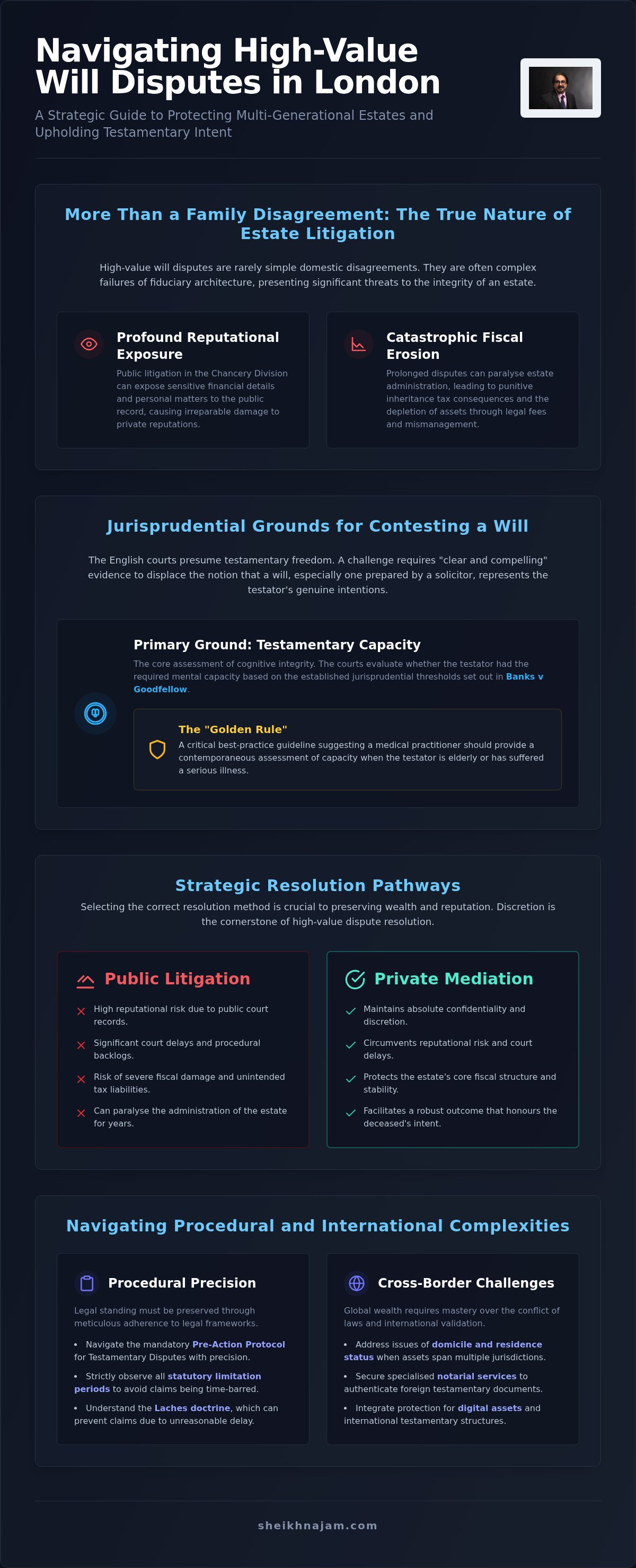
The transition from a nascent disagreement to formal litigation in the Chancery Division is governed by the Pre-Action Protocol for Testamentary Disputes. This procedural framework is designed to facilitate the early exchange of information and encourage the use of Alternative Dispute Resolution, thereby avoiding the necessity of a full trial where possible. In the context of will disputes London, adherence to this protocol is not merely a procedural formality but a strategic imperative. Failure to comply with these mandatory steps can result in severe cost sanctions, even for a party that eventually succeeds on the merits of their case. The protocol demands a level of transparency that, whilst potentially uncomfortable for some, serves to clarify the legal and factual issues at the earliest possible stage.
Timing is of the essence when navigating the intersection of statutory limitation periods and equitable doctrines. Whilst certain claims, such as those brought under the Inheritance (Provision for Family and Dependants) Act 1975, must be issued within a strict six-month window from the Grant of Probate, other challenges are subject to the doctrine of Laches. This equitable principle allows the court to bar a claim if there has been an unreasonable delay that makes it inequitable to grant relief. For the Master Advisor, the objective is to balance the need for thorough investigation with the requirement for prompt action, ensuring that no tactical advantage is lost to the passage of time.
The Larke v Nugus Request
A cornerstone of the investigative phase is the "Larke v Nugus" enquiry, a formal request for information directed at the solicitor who drafted the disputed will. This process allows claimants to obtain the drafting solicitor’s complete file, including contemporaneous notes regarding the testator's instructions and the solicitor's own assessment of testamentary capacity. These file notes often serve as primary evidence in capacity challenges, as they provide a direct window into the testator's state of mind at the time of execution. Analysing the "statement of preparation" for inconsistencies or procedural lapses is a critical step in identifying the structural weaknesses of a will before committing to the rigours of litigation.
Caveats and Warnings: Freezing the Grant of Probate
To prevent the premature distribution of assets, a party may enter a caveat at the Probate Registry, which effectively halts the administration of the estate for a period of six months. This tactical manoeuvre provides the necessary time to conduct investigations without the risk of the estate being depleted. However, executors can challenge a caveat by issuing a "warning," to which the caveator must respond with an "appearance" to make the caveat permanent until the dispute is resolved. This technical exchange requires absolute precision, as an incorrectly managed caveat can lead to personal liability for costs. For those requiring a meticulous assessment of their standing in contentious probate, understanding these procedural nuances is the first step toward a robust resolution.
Integrated Fiduciary Defence: The Sheikh Najam Approach
The Sheikh Najam methodology transcends the traditional, siloed approach to litigation, instead advocating for a holistic synthesis of contentious probate London with advanced estate planning and international tax strategy. It's a multi-disciplinary framework where the resolution of will disputes London is treated as a critical realignment of the estate’s fiduciary architecture. We don't merely seek to conclude a conflict; we aim to ensure that the resulting settlement is harmonised with the long-term fiscal objectives of the family office. This requires a profound understanding of how a mid-litigation concession might impact inheritance tax exemptions or trigger unintended regulatory scrutiny under global financial crime compliance standards.
Precision is mandatory. Every strategic move must be calibrated against the risk of asset depletion and the necessity of maintaining the estate's structural integrity. By positioning the practitioner as a Master Advisor who operates at the intersection of several complex fields, we provide a level of command and control that generalist firms cannot replicate. This approach prioritises the preservation of wealth whilst navigating the most acrimonious of testamentary challenges with absolute professional rigour.
Digital Assets and Modern Succession
The contemporary estate often comprises a significant portfolio of digital assets, including cryptocurrency, non-fungible tokens (NFTs), and digital intellectual property, all of which present unique challenges in the context of will disputes London. A primary fiduciary duty in these instances is the immediate securing of cryptographic private keys to prevent the permanent loss of value during the litigation process. Determining the legal "situs" of these intangible assets is equally critical, as it dictates which jurisdictional laws apply to their distribution and taxation. Successfully resolving these disputes requires a technical literacy that matches the legal complexity of the claim, ensuring that the digital estate is not only protected but correctly accounted for in the final settlement.
The Finality of Strategic Resolution
Achieving a resolution is only half the objective; the other half is ensuring that the resolution remains final and immune to future challenges. We construct settlement deeds with meticulous attention to detail, utilising indemnity clauses and comprehensive releases to prevent the resurgence of claims. Proactive measures, such as the strategic use of Lasting Powers of Attorney, are integrated into the post-dispute administration to safeguard against future capacity-related conflicts. This forward-looking perspective ensures a seamless transition from conflict to stability. Discretion remains paramount. By aligning the settlement with the estate’s international tax structures, we ensure that the final outcome is both legally robust and fiscally efficient.
Securing the Fiduciary Future Through Strategic Resolution
Navigating the intricate landscape of will disputes London requires a departure from conventional litigation tactics in favour of a multi-disciplinary, fiduciary-led strategy. We've established that the protection of high-value estates rests upon the precise application of the Banks v Goodfellow criteria and a meticulous adherence to pre-action protocols. By prioritising private mediation over the public scrutiny of the Chancery Division, executors and beneficiaries can preserve the estate's fiscal centre whilst ensuring that the resolution adheres to complex international tax and digital asset frameworks. This integrated approach ensures that the deceased's true intentions are vindicated without compromising the structural integrity of the wealth being transferred.
As a TEP Accredited Practitioner with a foundation in City of London academic rigour, Sheikh Najam provides the high-level command required for cross-border fiduciary litigation. You can instruct Sheikh Najam TEP for strategic dispute resolution to ensure your most complex testamentary challenges are managed with absolute precision. Securing a discreet and legally robust outcome is the ultimate safeguard for your family's legacy. Your affairs deserve the meticulousness that only a seasoned expert in the intersection of law and private wealth can provide.
Frequently Asked Questions
What are the most common grounds for contesting a will in London?
The primary grounds for initiating will disputes London include a lack of testamentary capacity under the Banks v Goodfellow criteria, undue influence involving actual coercion, and a lack of knowledge and approval regarding the document's contents. Claimants may also cite fraudulent calumny, where a beneficiary's mind was poisoned by false aspersions, or procedural defects in the will's execution. Each ground requires a specific evidentiary threshold to displace the presumption of validity afforded to professionally drafted documents.
How long do I have to dispute a will under the Inheritance Act 1975?
Claims brought under the Inheritance (Provision for Family and Dependants) Act 1975 must be issued within a strict statutory window of six months from the date the Grant of Probate is issued. Whilst the court possesses a discretionary power to permit late applications, such extensions are granted only in exceptional circumstances where a compelling justification for the delay is provided. This rigid timeline necessitates immediate action to preserve one's legal standing in will disputes London.
Can an executor be removed during a will dispute in the High Court?
The High Court retains the jurisdiction to remove an executor under Section 50 of the Administration of Justice Act 1985 if their continued involvement jeopardises the estate's administration. This remedy is typically reserved for instances of profound conflict of interest, financial mismanagement, or a total breakdown in communication that renders the fiduciary relationship untenable. The court prioritises the welfare of the beneficiaries and the efficient distribution of assets over the executor's personal right to act.
How does the "Larke v Nugus" request impact a testamentary challenge?
A Larke v Nugus request serves as a mandatory pre-action investigative tool that compels the drafting solicitor to disclose their full file and a detailed statement of preparation. This disclosure provides contemporaneous evidence of the testator's instructions and the solicitor's assessment of their cognitive state at the time of execution. It's an essential mechanism for identifying structural weaknesses in a will's origin before committing the estate to the significant expenses of formal litigation.
What is the cost of contesting a will in London for high-value estates?
The financial implications of high-value estate litigation are governed by the "loser pays" principle, where the unsuccessful party is generally ordered to indemnify the victor's legal costs. Beyond the direct professional fees, one must account for the potential depletion of the estate's liquid assets and the disruption of complex tax structures during the proceedings. A meticulous cost-benefit analysis is required to ensure that the pursuit of a judicial decree doesn't result in a Pyrrhic victory.
Is mediation compulsory for will disputes in England and Wales?
Whilst mediation isn't strictly compulsory, the Civil Procedure Rules place a heavy emphasis on Alternative Dispute Resolution (ADR) as a means of conserving judicial resources. A party that unreasonably refuses to engage in mediation may face punitive cost sanctions from the court, regardless of the eventual outcome of the trial. For high-net-worth individuals, mediation offers a strategic advantage by providing a confidential forum to resolve complex conflicts without the risks of public exposure.
How are international assets handled in a London-based will dispute?
International assets are managed through a sophisticated analysis of the testator's domicile and the specific conflict of laws principles applicable to the jurisdictions involved. The English courts coordinate with foreign registries, often requiring notarial authentication to verify the validity of overseas testamentary instruments. This process ensures that the distribution of global wealth remains compliant with both domestic probate law and international tax treaties, maintaining the estate's structural integrity across various borders.
What happens if a will is found to be invalid by the court?
If the court declares a will invalid, the estate's distribution reverts to the terms of the most recent valid testamentary document previously executed by the deceased. In instances where no prior valid will exists, the estate is distributed according to the statutory rules of intestacy, which provide a rigid hierarchy of beneficiaries. This outcome often contradicts the testator's actual intentions, highlighting the critical importance of ensuring every will is robustly drafted and shielded from potential challenges.


Comments