Commercial Arbitration Clause Drafting: 2026 Practical Guide

What if a clause intended to prevent procedural uncertainty becomes the first point of dispute? Commercial arbitration clause drafting is not simply a matter of inserting standard wording. It means designing a process that fits the contract, the parties’ commercial priorities and the disputes that may arise.
Choices about the seat, governing law, institutional or ad hoc procedure, tribunal appointments and escalation steps can affect how a dispute is conducted and whether the clause works as intended. For UK-seated arbitration, the Arbitration Act 2025, in force from 1 August 2025, also makes careful consideration of the arbitration agreement’s governing law particularly important.
This guide explains the main decisions to address before agreeing contract terms, compares institutional, ad hoc and multi-tiered clauses, and considers how cross-border factors can shape the drafting. It also shows how to assess a clause against the transaction’s likely dispute profile and where jurisdiction-specific legal analysis is needed before execution. The aim is a clearer, more coherent procedural framework that forms part of a wider commercial dispute prevention and resolution strategy.
Table of Contents
Why commercial arbitration clause drafting deserves attention before a dispute
Which decisions shape a well-drafted commercial arbitration clause?
Institutional, ad hoc or multi-tiered arbitration: compare the clause structures
How to draft and review a commercial arbitration clause step by step
Connect clause drafting with commercial dispute prevention and resolution
Why commercial arbitration clause drafting deserves attention before a dispute
An arbitration clause refers a defined category of disputes between the parties to arbitration, rather than leaving the forum to be decided after a disagreement arises. Its scope matters. It might cover disputes under the agreement, its interpretation or termination, or a wider range of related claims. Commercial arbitration clause drafting should therefore begin by defining the intended reach of the process, not by selecting standard wording in isolation.
Negotiation is the practical time to make these choices. While considering the transaction as a whole, the parties can decide which disputes should follow the same process and how that process should work. Once relations have deteriorated, even agreeing on procedure may become contentious. Agreeing to arbitrate is also distinct from selecting the rules and procedures: the clause can establish the obligation to arbitrate, while additional terms or incorporated rules address matters such as tribunal constitution and administration.
What does a commercial arbitration clause do?
The clause allocates disputes within its defined scope to a private adjudicative process. It does not replace the contract’s substantive obligations, such as delivery, payment or service standards. Those obligations determine the parties’ rights and duties; the dispute provision establishes how specified disagreements are resolved. A general overview of the arbitration clause can explain its common function, but appropriate wording depends on the agreement and applicable law.
Illustrative example, not legal advice: a cross-border supply contract could refer disputes about delivery, product specifications or payment to arbitration. Whether that wording also captures a related misrepresentation claim or a dispute involving another agreement depends on the clause and circumstances. Defining the intended scope is a substantive drafting decision, not a formality.
Which commercial agreements may need tailored dispute provisions?
The transaction and the parties’ relationship shape the drafting priorities. A cross-border supply agreement may involve delivery obligations, counterparties in different jurisdictions and claims connected with related contracts. A services agreement may require attention to the relationship between disputes about ongoing performance and termination. In a shareholder agreement, relevant parties and potential claims may involve ownership rights or governance. A joint venture may involve several connected agreements, so inconsistent dispute provisions could leave uncertainty about where a particular disagreement belongs.
Review the contract network as well as the principal document. Identify who is bound, which related agreements could generate overlapping claims and where enforcement may be sought. Arbitration is not automatically preferable to litigation in every commercial relationship. The appropriate forum depends on the parties’ objectives, likely disputes and relevant legal framework. Enforceability and effect also depend on the governing law, the clause’s construction and the circumstances. These questions form part of a wider commercial dispute prevention and resolution strategy, considered before a dispute fixes the parties’ positions.
Which decisions shape a well-drafted commercial arbitration clause?
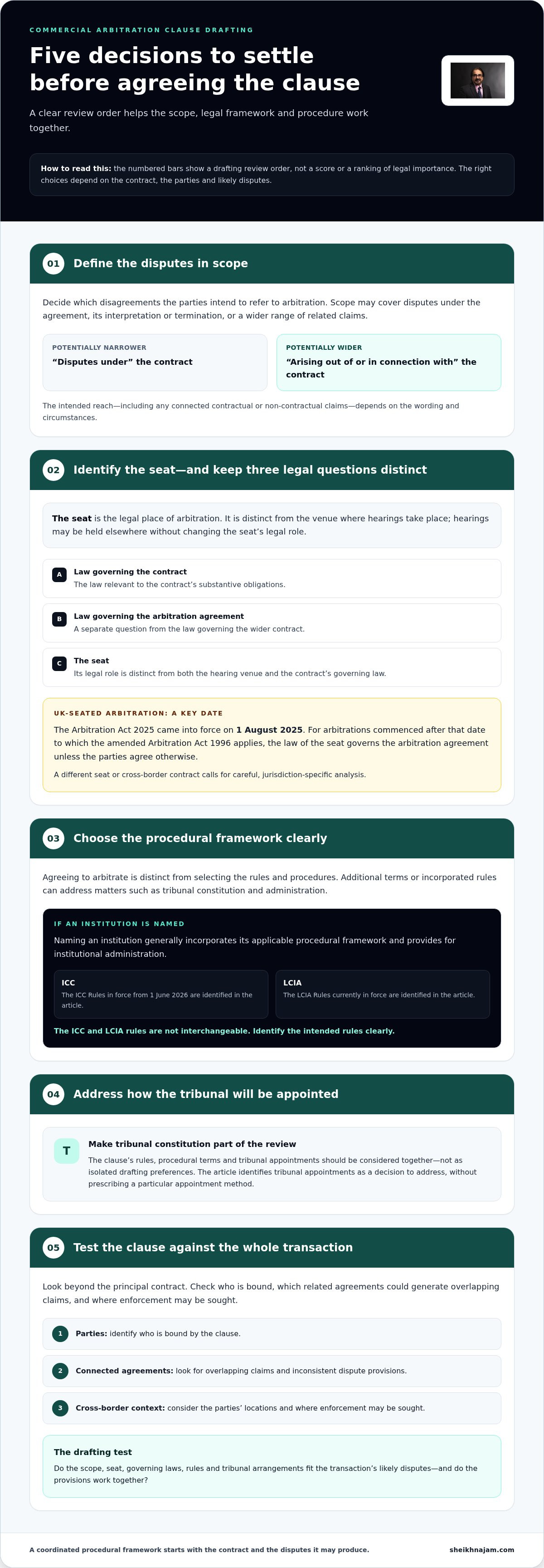
A clause’s effectiveness depends on how its components work together. Scope, seat, governing law, procedural rules and tribunal appointments should not be selected as isolated drafting preferences. Each affects which disputes enter arbitration and how the process is constituted. Commercial arbitration clause drafting therefore calls for a coordinated assessment of the contract, the parties’ locations and the legal framework relevant to the chosen seat.
How should the clause define disputes and the seat?
Start by deciding how far the referral should reach. Wording limited to disputes “under” a contract may be narrower than language covering disputes “arising out of or in connection with” it. The right formulation depends on which claims the parties intend to include, including any connected contractual or non-contractual claims. The clause should also identify the seat: the legal place of arbitration, distinct from the venue where hearings take place. Hearings may be held elsewhere without changing the seat’s legal role.
Keep three questions distinct: the law governing the contract, the law governing the arbitration agreement and the seat. They may point to different jurisdictions, and their interaction can affect interpretation and procedure. For arbitrations commenced after 1 August 2025 to which the amended Arbitration Act 1996 applies, the Arbitration Act 2025 provides that the law of the seat governs the arbitration agreement unless the parties agree otherwise. A clause involving another seat or a cross-border contract calls for careful, jurisdiction-specific analysis.
What should the clause say about rules and the tribunal?
Naming an institution, such as the International Chamber of Commerce (ICC) or the LCIA, generally incorporates its applicable procedural framework and provides for institutional administration. The ICC Rules in force from 1 June 2026 and the LCIA Rules currently in force are not interchangeable, so identify the intended rules clearly. Ad hoc arbitration, by contrast, is not administered by an institution. Parties may select the UNCITRAL Arbitration Rules, but should ensure the clause provides a workable appointment mechanism and addresses procedural gaps.
Tribunal size, appointment method and language should also fit together. A sole arbitrator may suit a different dispute profile from a three-member tribunal. State how appointments are made and what happens if the agreed mechanism cannot be followed. Selecting a language can affect submissions, evidence and hearings, particularly where parties operate across borders. The American Arbitration Association (AAA) guidance on clause drafting offers another reference point, though the governing law and chosen rules remain central to the drafting exercise.
Before execution, test the provisions as a whole. Does the scope align with related agreements? Can the tribunal be constituted under the selected rules? Do the seat and governing-law choices express the parties’ intentions? A mismatch can create uncertainty when the process is needed. Where these choices intersect with cross-border operations, a discussion of the clause’s legal and commercial context can help identify issues for tailored review.
Institutional, ad hoc or multi-tiered arbitration: compare the clause structures
The choice between institutional, ad hoc and multi-tiered arbitration is about how the process will be organised, not a reliable way to predict cost, speed or outcome. Each structure allocates procedural responsibility differently. In commercial arbitration clause drafting, the key question is which arrangement fits the contract’s dispute profile and the parties’ ability to work with the process if a disagreement arises.
When might institutional or ad hoc arbitration fit?
Institutional arbitration uses an organisation’s rules and administrative framework. The rules may address tribunal appointments, challenges and procedural steps, while the institution performs the administrative functions set out in its framework. The ICC’s revised rules took effect on 1 June 2026; the LCIA’s 2020 Rules remain in force as of October 2026. Identify the selected institution and applicable rule version precisely.
Ad hoc arbitration is not administered by an arbitral institution. The parties can agree on procedural rules, such as the UNCITRAL Arbitration Rules, together with an appointment mechanism and any supporting arrangements required by the clause. This places greater emphasis on complete, workable drafting. Neither structure is inherently superior. The choice turns on the parties’ preferred level of institutional administration, the likely complexity of the dispute and the legal framework.
How should multi-tiered and expedited provisions be assessed?
A multi-tiered clause requires an earlier step, often negotiation or mediation, before arbitration. Make the sequence express: specify how each stage begins, any deadline and the event that allows escalation. For example, do not leave the parties uncertain about whether mediation must be attempted before arbitration begins or how the process advances if one party does not participate. The effect of these conditions can depend on the governing law and the wording.
Expedited procedures also require deliberate selection. They are governed by the chosen rules and their applicable criteria, which may include thresholds or other conditions, and those provisions can change. The ICC’s 2026 Rules introduced an opt-in Highly Expedited Arbitration Procedure. This illustrates why a clause should be checked against the rules applicable to the agreement rather than relying on an assumed standard. Consider whether the likely dispute’s value, factual complexity and urgency fit a more compressed procedure.
A practical comparison should connect each structure to the transaction, rather than rank the options in the abstract:
Institutional: assess whether the organisation’s rules and administrative framework suit the anticipated disputes and the parties’ procedural preferences.
Ad hoc: consider whether the parties can specify adequate procedural and appointment arrangements without institutional administration.
Multi-tiered: map each preliminary stage, trigger, deadline and escalation point against the commercial relationship.
Expedited: compare the likely dispute’s complexity and urgency with the current rules and eligibility criteria.
Review these choices together, including how they interact with related contracts. Drafting around the transaction, rather than copying a standalone form, helps the clause express a coherent dispute strategy.
How to draft and review a commercial arbitration clause step by step
A disciplined review starts with the transaction, not a precedent clause. This workflow turns commercial priorities into a coherent dispute mechanism and highlights issues for legal analysis before the contract is executed.
Map the parties and contractual relationship. Identify every contracting party, its jurisdiction and role, then note any connected supply, services, shareholder or joint venture agreements. Consider whether the same dispute could involve parties or obligations across more than one document.
Identify foreseeable disputes. Consider the claims the relationship could realistically generate, such as disagreements about performance, payment, termination or contractual interpretation. Decide whether the clause should capture only disputes under the agreement or a wider category connected with it.
Record the commercial priorities. Establish which considerations matter to the parties, such as procedural structure, confidentiality, a defined route for early resolution or a suitable process for complex claims. Treat these as factors to balance, not automatic reasons to choose one form of arbitration.
Assess cross-border considerations. Map where the parties and relevant assets are located, and where recognition or enforcement of an award may become relevant. These details can inform the proposed seat, governing-law choices and need for jurisdiction-specific advice. Do not reduce them to a generic “international” clause.
Set the procedural architecture. Decide the intended scope, seat, applicable rules, tribunal composition, appointment method and language. If negotiation or mediation is to precede arbitration, specify the sequence, commencement trigger, deadline and point at which a party may proceed to the next stage.
Test each provision against the others. Check that the named institution and rules match, the appointment mechanism works with the selected framework, and the clause uses consistent terms for the parties, disputes and stages. Review it alongside related agreements to identify conflicting seats, procedures or scopes.
Complete a legal and execution review. Examine the governing law of both the contract and arbitration agreement, the legal effect of the chosen seat and the relevant statutory framework. For a UK-seated arbitration, confirm how the Arbitration Act 1996, as amended by the Arbitration Act 2025, which came into force on 1 August 2025, applies in light of the circumstances and timing of the arbitration. Then ensure the final text is incorporated into the correct contract version and agreed by the relevant parties.
This sequence makes the clause part of the transaction’s wider risk and dispute strategy, rather than an isolated provision. Where cross-border arrangements or linked contracts create competing procedural considerations, tailored legal review can clarify which issues need resolving before execution. Discuss your commercial arbitration clause in the context of the agreement and its related obligations.
Connect clause drafting with commercial dispute prevention and resolution
An arbitration clause is not simply a mechanism activated when negotiations fail. Considered when a contract is formed, it can help the parties understand how disagreements are to be addressed, which issues fall within the agreed process and what procedural steps apply. That clarity may inform negotiation by making the intended route explicit, although it cannot determine the merits of a future claim or guarantee a particular result.
This is why commercial arbitration clause drafting belongs within a broader approach to dispute prevention and resolution. The clause should reflect the commercial relationship, the parties’ priorities and the wider contract structure. Its design may also affect how parties assess their position during a dispute. A clearly sequenced escalation process, for example, identifies the next procedural step, while ambiguous triggers can themselves become a point of contention.
Sheikh Najam TEP provides commercial arbitration within its “Dispute Prevention & Resolution” service. For UK companies with international operations, relevant legal and procedural questions may extend across contractual relationships and jurisdictions. Consider the clause alongside that wider context, without assuming one structure is suitable for every transaction.
When does a clause merit strategic legal review?
Closer analysis is particularly valuable where parties are based in different jurisdictions, several agreements govern connected aspects of a transaction, or performance obligations are complex. A supply relationship involving separate framework, purchase and services agreements, for instance, may raise questions about whether related claims follow a consistent process. The appropriate structure depends on the facts, intended scope and applicable law. A model clause cannot be treated as universally suitable. The firm’s specialist legal work includes cross-border legal matters.
What should a consultation help the parties clarify?
A focused discussion should establish the likely dispute profile, the parties’ procedural preferences and how the arbitration provision fits with the contract and related agreements. It can also identify questions requiring specific legal analysis, including the interaction between the seat, governing law, rules and enforcement context. The purpose is to develop a coherent strategy informed by the transaction, not to promise enforceability or a favourable outcome.
For advice on how the dispute mechanism should fit your commercial arrangements, contact Sheikh Najam TEP to discuss your arbitration clause.
Put your dispute strategy on a clearer footing
The contract gives the parties an opportunity to make considered choices before commercial pressures narrow the room for agreement. Treat the clause as part of the transaction’s wider risk framework. Its purpose is not to predict every disagreement, but to establish a process that reflects the parties’ intentions and the legal context in which it may operate. Careful commercial arbitration clause drafting can bring that strategy into focus.
Sheikh Najam advises UK companies, including those with international operations, on cross-border legal matters and provides “Dispute Prevention & Resolution” services, including commercial arbitration. A considered review can help assess whether the proposed mechanism aligns with the contractual relationship and identify where further legal analysis may be needed, without presuming a particular outcome.
Discuss your commercial dispute-resolution requirements and consider how the clause can support a coherent approach to future disputes. A considered next step can put the agreement on a more deliberate footing.
Frequently Asked Questions
Can an arbitration clause be included in a commercial contract after negotiations have begun?
Yes. Parties can discuss and negotiate an arbitration clause before the contract is finalised. A proposal during negotiations is not, by itself, an effective contractual amendment. Changing an existing agreement generally requires valid agreement between the parties and compliance with its amendment and execution provisions. The applicable governing law may also affect the analysis. Before relying on a newly agreed dispute term, have the relevant contract documents and required formalities reviewed.
Is an arbitration clause enforceable if the main contract is challenged?
It may remain operative even if the wider contract is challenged, but the doctrine of separability does not resolve every dispute about the arbitration agreement. The answer depends on the nature of the challenge, the evidence and the law applicable to the arbitration agreement. The chosen seat and legislation in force there may also be relevant. If the challenge alleges that the arbitration agreement itself is invalid, obtain advice focused on the facts and governing framework.
Can a commercial arbitration clause cover disputes under several related agreements?
It can be drafted to address disputes connected with multiple agreements, but a clause in one contract should not be assumed to govern claims under another. A framework agreement and a later project contract, for example, may involve different parties, governing laws or dispute provisions. Compare the documents’ wording and consider whether their parties can be brought within a coordinated mechanism. This aspect of commercial arbitration clause drafting requires analysis of the entire contractual structure and applicable law.
What happens if a party refuses to participate in arbitration?
A refusal to participate does not necessarily prevent arbitration from continuing, but the position depends on the agreement, applicable rules, seat and procedural law. The tribunal or appointing body may have processes for dealing with non-participation, subject to the governing framework and procedural fairness. A proceeding continuing without one party is separate from whether an eventual award can be recognised or enforced. Obtain prompt, jurisdiction-specific advice before deciding how to respond.
Can parties seek urgent court relief despite an arbitration clause?
Possibly, but the availability and procedure for urgent court relief depend on the clause, seat, applicable law and circumstances requiring intervention. Interim relief addresses an immediate issue while the substantive dispute remains for later determination; it is not necessarily a decision on the merits. Assess the relevant court powers and arbitration framework in context, rather than assuming the clause permits or excludes every urgent application.
Can an arbitration clause combine mediation and arbitration?
Yes. A contract can provide for mediation before arbitration, but the wording should make clear what starts mediation, how long the parties have to pursue it and when arbitration may begin. An undefined obligation to negotiate before arbitration, for example, may leave uncertainty about whether a party has completed the required step. A defined escalation process is more precise, though its interpretation still depends on the wording, applicable law and chosen rules.
Does an arbitration clause automatically keep proceedings confidential?
No universal assumption of confidentiality should be made without examining the clause, applicable law and chosen rules. Privacy of a hearing and legal duties restricting disclosure are distinct questions. The latter may also be affected by permitted disclosures or the circumstances of a particular dispute. If sensitive commercial information is involved, identify the confidentiality the parties require and consider express drafting, including its scope, exceptions and interaction with the applicable arbitration framework.



Comments