How to Identify and Assess Financial Crime Risks

A financial crime risk assessment is not a checklist: it must show how risks arise in the particular business and how they are controlled. According to the UK legislation register, the UK Money Laundering Regulations 2017 require businesses to assess financial crime risks across the whole business under Article 18. The FATF 40 Recommendations set the international standards countries are expected to meet for anti-money laundering and countering terrorist and proliferation financing.
It is understandable that the FATF Methodology can seem remote from the practical decisions businesses must make. Its value lies in providing a disciplined way to identify where exposure may arise, assess its significance and determine whether controls address it.
This article explains how the FATF Methodology informs assessments of money laundering, terrorist financing and proliferation financing, as well as customer behaviour and transaction risks. It also outlines how to approach business-wide and customer assessments in the United Kingdom, so the analysis is structured, proportionate and useful when setting controls.
Table of Contents
Money laundering, terrorist financing and proliferation financing
Structure the assessment around the firm’s exposure, applicable obligations, control priorities and review process. The FATF Methodology provides an international framework for assessing money laundering, terrorist financing and proliferation financing risks.
Identify Relevant Financial Crime RisksMap how the firm’s customers, services, delivery channels and geographic connections could facilitate laundering. Consider terrorist financing and proliferation financing separately, since their sources, purposes and indicators may differ. The FATF 40 Recommendations set international standards addressing these threats. Include sanctions exposure where relevant to customers, transactions and business relationships.Review the assessment regularly and whenever a material trigger arises, such as a new service, delivery channel or regulatory change. Firms are also encouraged to assess business-wide risks formally each year, rather than simply refreshing previous documents.
Consider Applicable RegulationsIdentify the legal and supervisory framework applying to the firm’s activities. According to the UK legislation register, the UK Money Laundering, Terrorist Financing and Transfer of Funds (Information on the Payer) Regulations 2017 require firms to identify and assess the risk that they could be used for money laundering, including terrorist financing.According to the UK legislation register, the UK Money Laundering Regulations 2017 require businesses to assess financial crime risks across the whole business under Article 18. The FCA provides guidance through its Financial Crime Guide and SYSC provisions; relevant supervisory guidance depends on the firm’s sector.An inadequate assessment can leave material exposure unidentified and controls poorly matched to the risks. This may weaken prevention, monitoring and escalation, rather than demonstrate that identified risks have been addressed.
Apply a Risk-Based ApproachRank exposure according to the firm’s activities and the likelihood and impact of each risk. Apply closer scrutiny to higher-risk relationships, services or transactions, rather than using identical controls for circumstances with materially different exposure. A risk-based approach directs resources towards the firm’s most consequential vulnerabilities.Use the UK National Risk Assessment 2025 and the national proliferation financing risk assessment published in 2021 as relevant context. Apply FATF guidance alongside domestic requirements, then record why selected controls correspond to the identified risks.
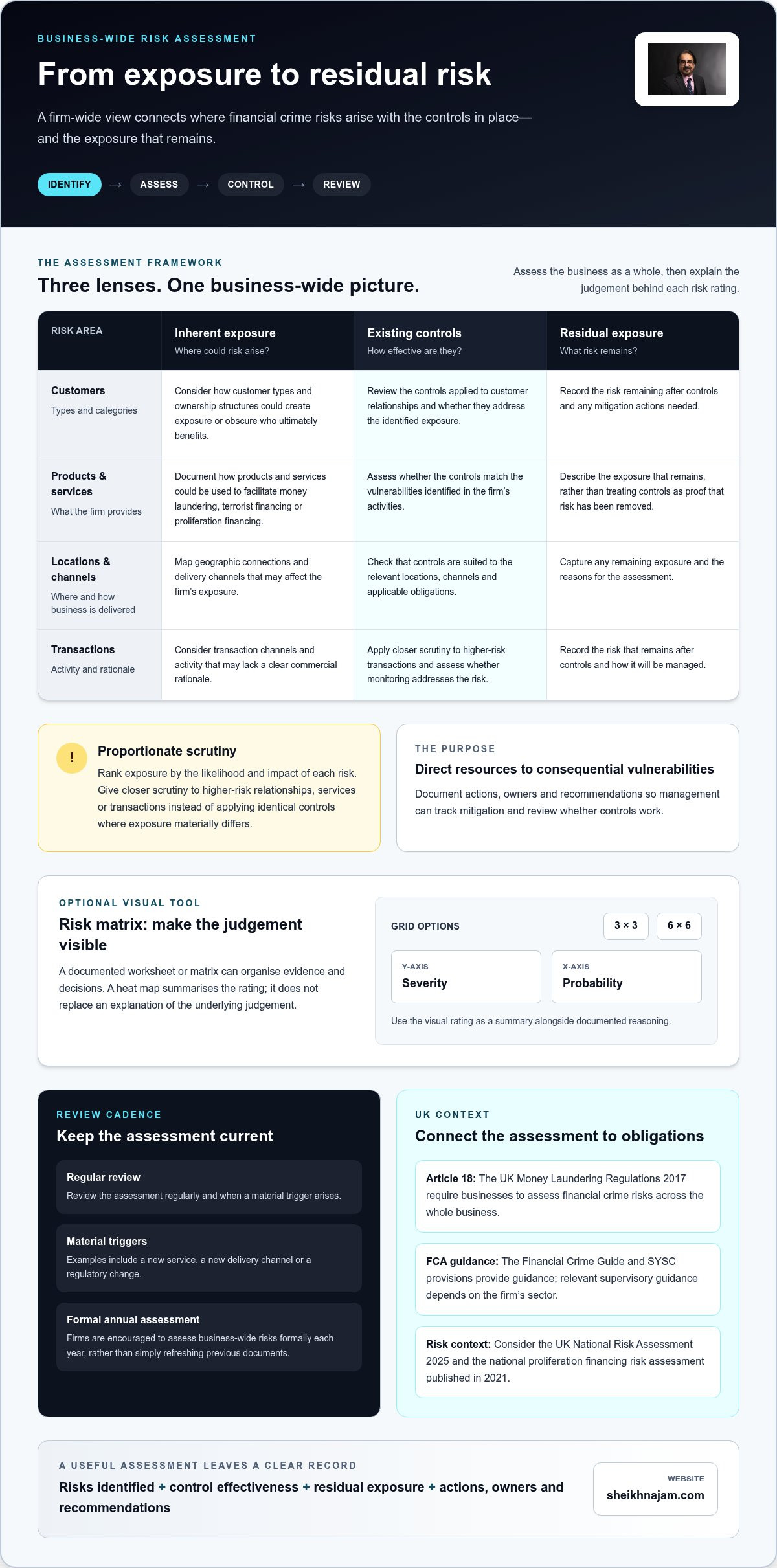
Assess Firm-Wide Money Laundering RisksDocument how risks arise across the business, including through customer types, products, services, locations and transaction channels. Assess inherent exposure, the effectiveness of existing controls and the residual risk after those controls. Record actions, owners and recommendations so management can track mitigation and review whether controls work.UK businesses can use a documented worksheet or risk matrix to organise evidence and decisions. A heat map may use a 3x3 or 6x6 grid, with probability on the X-axis and severity on the Y-axis. Treat the visual rating as a summary, not a substitute for explaining the underlying judgement.
Customer behaviours that may indicate risk
Record the evidence behind each customer risk assessment, including the reasons for its rating and any resulting action. Keep the assessment, due diligence records, supporting documents, decisions, approvals and review history together.
Segment customers before assessing individual relationships. Group them by business type, industry, size or customer category, then identify how exposure may differ between groups. For example, a complex ownership structure may obscure who ultimately benefits. Record how the structure affects your understanding of the customer, rather than treating complexity alone as proof of wrongdoing.
Compare behaviour with the customer’s stated purpose and expected activity. Note unexplained reluctance to provide ownership information, inconsistent explanations, repeated changes to instructions or pressure to complete a transaction without ordinary checks. Assess each signal in context: a discrepancy may have an innocent explanation, but unresolved inconsistencies can raise the customer’s risk rating and call for further scrutiny.
Make customer risk assessments proportionate and practical. Document the factors considered, evidence reviewed, rationale for the rating and resulting controls. A higher-risk rating should inform customer due diligence, transaction monitoring and other safeguards; it should not remain a label without practical consequences. Record who made the decision and whether senior management approved or reviewed it.
Test the quality of information obtained through referrers or intermediaries. Record the due diligence they performed, the evidence they supplied and the extent to which the firm relies on their work. If documentation is incomplete or leaves a material inconsistency unresolved, seek further information through the firm’s own process. Preserve the evidence and reasoning so a later reviewer can understand the decision.
Review customer risk when new information changes the relationship’s profile. Emerging risks may become apparent through altered ownership, a new business purpose, unexpected activity or repeated discrepancies between statements and records. Log the trigger, reassess the customer, record any control changes and assign follow-up action. Where a complex trust or estate structure raises related concerns, discuss the matter with Sheikh Najam TEP.
Transaction risk indicators
Assess each transaction against its commercial purpose, the customer’s profile and the available evidence. Monitoring should identify anomalies, prompt proportionate investigation and support timely action.
Identify Transaction Risk IndicatorsCompare the transaction’s purpose, amount, route and counterparties with the expected activity. An arrangement that lacks a coherent commercial explanation may indicate money laundering risk; unexplained payments or inconsistent supporting records also warrant examination. In one guide example, a firm continued paying a branch manager’s salary 25 years after the branch closed. The discrepancy was a clear reason to investigate and correct the underlying process.
Monitor TransactionsSet monitoring procedures around the risks identified in customer and business assessments. Review activity for departures from expected patterns, repeated transactions without an evident purpose, unusual counterparties or details that conflict with the stated rationale. Treat a system alert as a prompt for human review, not as a finding in itself. Record the evidence examined, decision reached and responsible person.
Investigate anomalies systematically. Compare the transaction with the customer’s known activity and the purpose of the relationship. Then examine available instructions, invoices, contracts or other records supporting the payment. If an inconsistency remains, document what is missing, which explanations were considered and why the activity does or does not change the assessed risk. This creates a traceable basis for the next control decision.
Assess sanctions exposure in the context of the transaction. Consider the parties, intermediaries, jurisdictions and payment route, then establish whether relevant details match the transaction records. A possible match requires careful assessment under the firm’s procedures; a name resemblance alone does not establish a sanctions breach. Preserve the screening result, supporting evidence and any escalation decision so another reviewer can follow the reasoning.
Apply controls proportionately to the identified risk. These may include enhanced review, additional evidence, closer monitoring or escalation under internal procedures. The control should address the specific weakness: for example, verify the transaction’s commercial rationale if its purpose is unclear. Assign an owner and record the action taken, rather than closing an alert without explaining how the concern was resolved.
Test whether controls operate as designed. Sample completed alerts and compare the original transaction details, evidence gathered, decision and escalation record. Review whether staff followed procedures and whether monitoring identified the intended anomalies. Test and review processes after enhancements, upgrades or automation, and document changes, findings and corrective actions. Senior oversight should examine recurring weaknesses and ensure improvements are implemented.
Escalate suspected activity in accordance with reporting procedures. In the UK, businesses must send a Suspicious Activity Report to the National Crime Agency when they suspect a transaction relates to money laundering or terrorist financing, and should report before the transaction where possible. If suspicion arises after completion, send the report at the earliest opportunity. Record the relevant evidence and decision trail.
Business-wide risk assessments (BWRAs)
Build a business-wide assessment that explains where exposure arises, how controls respond and what action remains outstanding. Use it as a management tool, not merely a compliance record.
Map the firm’s operations before assigning risk ratings. Record its services, products, customer groups, delivery channels, geographic connections and reliance on intermediaries. For example, a firm serving several industries may face distinct risks across client segments, even when it provides the same service. Identify which activities create exposure and how a customer, transaction or service could be misused.Use a consistent method to compare exposures. Describe each risk, its source, the activity affected and the evidence supporting the assessment. A clear record helps senior management distinguish a genuine change in exposure from a change in wording or presentation.
Assess inherent risk before considering mitigating controls. Consider the nature and scale of each activity, the customers involved and how services are delivered. Then evaluate whether existing policies and controls address the specific risk, rather than assuming their existence proves their effectiveness. For example, a documented approval procedure has limited value if staff do not follow it in practice.
Determine residual exposure by weighing the risk that remains after controls operate. Record the rationale, evidence and limitations behind each judgement. A control may reduce one risk while leaving another risk associated with the same activity substantially unchanged. Explain the distinction, then identify whether the remaining exposure calls for stronger monitoring, revised procedures or management attention.
Turn findings into a tracked action plan. For each recommendation, record an accountable owner, the control or policy to be changed, the intended outcome and progress. Link actions to the identified risk so management can see why each change matters. A general instruction to “improve monitoring” is less useful than specifying which activity needs review and what evidence will demonstrate improvement.Discuss material findings and proposed mitigations with senior management. Record decisions, challenge and approval, including why an action was accepted, amended or deferred. This creates governance evidence and makes unresolved exposure visible to those responsible for oversight.
Revisit the assessment when changes affect the firm’s risk profile, such as new services, customer segments or delivery arrangements. The FCA’s 2025 multi-firm review examined business-wide and customer risk assessment processes, underscoring the importance of assessments that reflect actual operations. Compare new information with previous assumptions and amend the analysis where evidence warrants it.Keep the methodology, source material, ratings, control evaluations, management decisions and action history together. A reviewer should be able to trace the reasoning from identified exposure to mitigation. Use that record to assess whether policies still address the risks they are intended to manage, and whether exposure remains despite them.
Identifying and assessing financial crime risks
Make the assessment traceable: connect evidence about exposure to a reasoned risk rating and proportionate mitigation. The central test is whether the analysis explains how risks arise and why the chosen controls address them.
Gather internal and external information before rating exposure. Review services, customer categories, transaction patterns, geographic connections, staff reports and control findings. Compare these sources to identify where actual practice differs from documented procedures. For example, a service used by several industries may expose the firm to distinct threats, even if its formal description has not changed.Consider emerging risks as well as established ones. Record what has changed, which activities could be affected and what evidence supports that conclusion. This helps prevent the assessment from relying solely on historic incidents or assumptions that no longer reflect the firm’s operations.
Segment the customer base to make comparisons meaningful. Accountancy firms can group clients by industry, size or client type, then identify characteristics associated with different exposure. Assess whether reliance on a referrer’s customer due diligence is appropriate by considering the work performed and the quality of evidence supplied. Record limitations and how they affect the assessment.Distinguish relevant indicators from unsupported assumptions. A customer category may warrant closer analysis, but the assessment should explain the specific activity or vulnerability that creates the concern.
Rate each identified risk by considering both likelihood and impact. Explain the reasoning behind each judgement, using available evidence rather than relying on an unexplained label. A heat map may use a 3x3 or 6x6 grid, with probability on the X-axis and severity on the Y-axis. Define rating criteria consistently, so similar risks receive comparable treatment across teams.Use the visual rating as a summary, not as the analysis itself. Document why a risk has a particular rating and what could change it.
Evaluate controls against the exposure they are intended to mitigate. Record whether each control is appropriately designed, understood by staff and implemented in practice. The FCA Financial Crime Guide addresses structured, documented assessments of fraud, bribery and other risks in sections 2.2.4, 4.2.1 and 6.6.2. A control inventory alone cannot explain whether the overall response is coherent.The Wolfsberg FAQs (2015) emphasise holistic assessment rather than prescriptive mapping of each risk to a control. Consider how measures work together, where coverage remains incomplete and whether residual exposure requires further action.
Document the methodology, evidence, assumptions, decisions and recommended actions. Explain material rating changes, assign responsibility for mitigation and record how management considered unresolved exposure. Review the assessment when emerging risks or operational changes undermine its assumptions, then preserve the revised reasoning and approval history.A useful assessment connects each risk to evidence, a reasoned rating and an accountable response. To discuss how that analysis applies to a complex matter, discuss your risk assessment.
Sheikh Najam TEP: Notarial Services
Sheikh Najam TEP provides Notarial Services and Financial Crime & Compliance Advisory for matters requiring careful documentation and risk analysis. Where an assessment identifies complex ownership, cross-border arrangements or control weaknesses, its findings can inform a more structured compliance response. Notarial Services address the formal execution or authentication of documents; they are distinct from assessing or mitigating financial crime exposure. For connected private-wealth matters, Trust and Estate Planning or Inheritance Tax Planning may also be relevant to the wider context.
If you need guidance on how financial crime and compliance considerations apply to your circumstances, contact Sheikh Najam TEP.
Turn your assessment into considered action
A financial crime risk assessment has lasting value when its conclusions inform decisions beyond the immediate compliance process. Consider how identified risks interact with governance, documentation and the structure of a person’s wider affairs, particularly where trusts, estates or cross-border interests are involved. This broader perspective can help ensure compliance considerations are not treated in isolation from related legal and administrative responsibilities.
Sheikh Najam TEP offers Trust and Estate Planning and Inheritance Tax Planning for matters involving complex private wealth, alongside Notarial Services for relevant document formalities. These are distinct areas of work, and their relevance depends on the matter at hand. A carefully framed discussion can help clarify which considerations belong within the compliance assessment and which require separate attention.
Contact Sheikh Najam TEP to discuss your needs and determine a considered next step for your circumstances.
Frequently Asked Questions
What is the FATF Methodology?
The FATF Methodology is the framework used to assess how countries meet international standards and address financial crime threats. It examines technical compliance with the FATF 40 Recommendations and effectiveness through 11 Immediate Outcomes. For a business, its value is as a reference point: it helps frame questions about threats, vulnerabilities and mitigation, whilst the organisation’s own assessment must reflect its activities and applicable UK requirements.
Why Write an NRA?
A National Risk Assessment (NRA) helps a country identify and understand the threats and vulnerabilities that shape its exposure to financial crime. Its findings inform national priorities and help public authorities and regulated sectors focus attention on material risks. UK businesses can use the national assessment as context, then determine how its findings relate to their own customers, products and operations. The UK published a money laundering NRA in 2025 and a proliferation financing assessment in 2021.
What financial crimes should an organisation assess, including money laundering, terrorist financing, fraud and sanctions evasion?
Assess money laundering, terrorist financing, proliferation financing, fraud, bribery and relevant sanctions risks. Consider how each could arise through the organisation’s actual services, customers or transactions. For instance, assess whether a payment route could conceal its parties or purpose, and whether a customer or counterparty creates sanctions exposure. The FCA Financial Crime Guide addresses structured assessments of fraud, bribery and other risks, while FATF standards also cover terrorist and proliferation financing.
What UK laws and regulations govern financial crime risk assessments?
The principal statutory framework for firms within scope is the UK Money Laundering, Terrorist Financing and Transfer of Funds (Information on the Payer) Regulations 2017. According to the UK legislation register, these regulations require firms to identify and assess the risk that they could be used for money laundering, including terrorist financing. Article 18 addresses business-wide assessment. Supervisory context also includes the FCA’s Financial Crime Guide and SYSC, alongside relevant JMLSG and FATF guidance.
What factors should a business consider when assessing financial crime risk?
Consider internal and external factors, including the organisation’s size, structure, activities, products, services, customer base and delivery arrangements. Examine how ownership, intermediaries, locations and transaction patterns affect exposure. Then assess likelihood and potential impact using evidence, not unsupported assumptions. A new service, for example, may create risks that existing controls do not address. Record the rationale for each rating and consider whether planned mitigations are properly designed and understood by staff.
How do you conduct a financial crime risk assessment step by step?
Start by defining the assessment’s scope and gathering information about the organisation’s operations and customers. Identify relevant threats, assess likelihood and impact, then evaluate existing controls and remaining exposure. Set out corrective actions, assign responsible owners, and document the methodology and decisions. For example, if a new intermediary creates reliance on external due diligence, assess the quality of the evidence and adjust controls where needed. Review the assessment when operational or regulatory changes alter its assumptions.
How should firms assess customer, product, geographic and delivery-channel risks?
Assess each category separately, then consider how risks combine. For customers, examine business type, ownership and expected activity. For products, consider how their features could be misused. Geographic analysis should reflect relevant exposure linked to the customer or transaction, while channel assessment should consider whether remote onboarding or intermediaries limit the available evidence. Segmenting customers by industry, size or type can reveal differences obscured by an overall rating; document why each factor changes the assessment.



Comments