International Tax Planning for London Business Owners

Updated: Aug 26
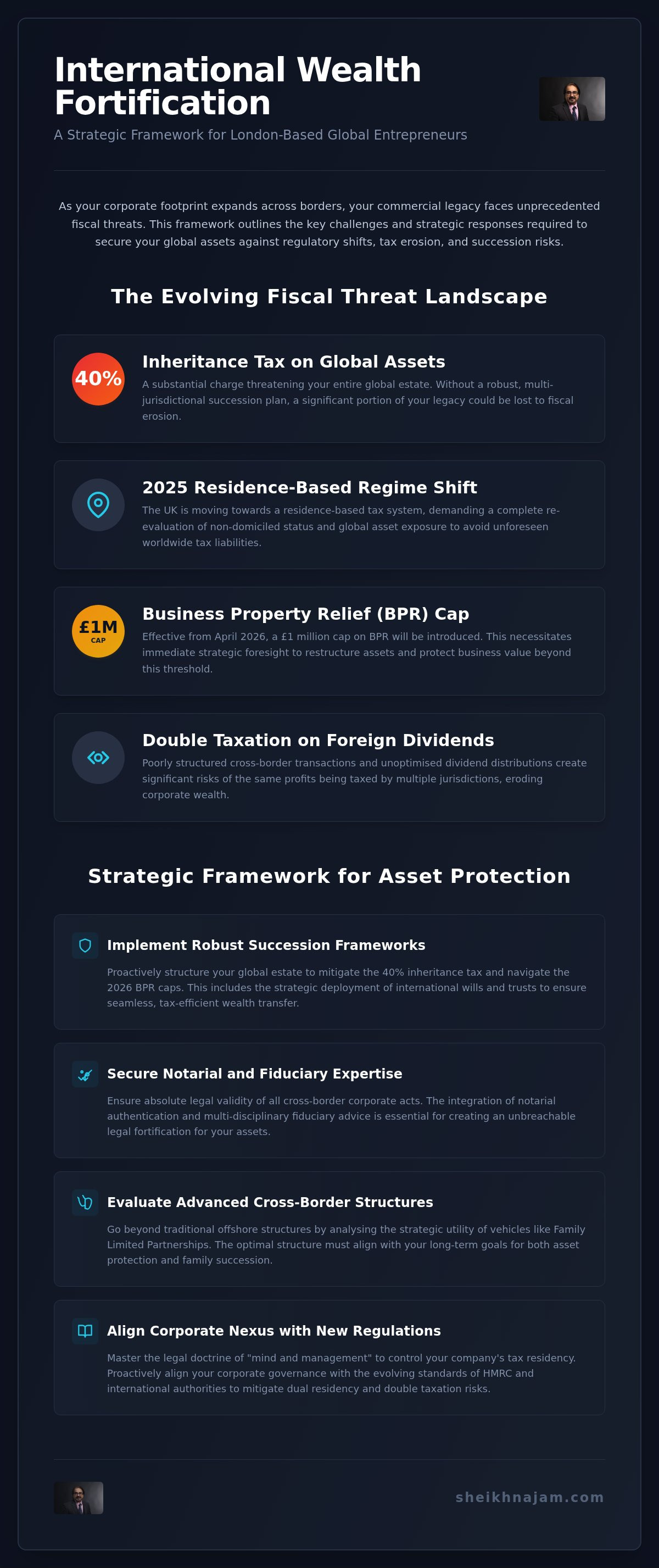
For the global entrepreneur established within the Square Mile, the preservation of private wealth is no longer a matter of simple accounting; it is an intricate exercise in multi-jurisdictional legal fortification. You likely recognise that as your corporate footprint expands across borders, the spectre of double taxation on foreign dividends and the complexities of the 2025 residence-based regime present existential threats to your commercial legacy. The risk of a 40% inheritance tax charge on global assets, particularly following the £1 million cap on Business Property Relief effective from April 2026, necessitates a level of strategic foresight that transcends traditional advisory roles.
This analysis provides an elite framework for international tax planning for business owners London, delivering a sophisticated synthesis of HMRC compliance and cross-border fiduciary structuring designed to protect your corporate interests. We shall examine the strategic deployment of international wills, the rigorous demands of multi-jurisdictional regulatory alignment, and the creation of a secure succession plan that ensures your global assets are insulated from fiscal erosion. By integrating notarial precision with multi-disciplinary legal expertise, we offer the clarity required to maintain command over your most complex financial affairs.
Table of Contents
Navigating the Intricacies of International Tax Planning for London Business Owners
For the sophisticated entrepreneur operating within the City, the scope of international tax planning for business owners London extends far beyond the mere reduction of immediate fiscal liabilities. It represents a profound commitment to the structural integrity of one's global enterprise. London remains a preeminent centre for such activity; it's a jurisdiction where institutional weight meets the meticulous precision of the Court of Faculties and the Society of Trust and Estate Practitioners (TEP). This discipline requires a transition from reactive compliance to proactive, strategic wealth preservation. One must distinguish between tactical tax mitigation, which often focuses on the short-term, and the broader, more academic pursuit of multi-jurisdictional fiduciary stability that ensures a legacy remains intact across generations.
The Evolving Global Regulatory Landscape
The current regulatory epoch is defined by unprecedented levels of transparency and the automatic exchange of information between sovereign states. Central to this shift is the OECD’s Pillar Two framework, which introduces a 15% global minimum tax rate for large multinational enterprises. Whilst many mid-market firms may fall below the primary revenue thresholds, the reporting requirements and the "substance" rules are increasingly influencing the core concepts of international taxation applied by HMRC. As we approach the 2026 fiscal year, where Business Property Relief (BPR) is capped at a combined £1 million per individual, structuring decisions must be made with absolute academic rigor. These changes signify a move towards a residence-based regime that demands a complete re-evaluation of non-domiciled status and global asset exposure.
The Interplay Between Corporate and Personal Liability
An entrepreneur’s private wealth is inextricably linked to their corporate nexus. It's a fallacy to believe that corporate tax obligations can be hermetically sealed from personal inheritance tax risks. Hidden leakages often occur during cross-border transactions; these include unoptimised dividend distributions or poorly documented transfer pricing. Establishing a baseline for global compliance requires a polymathic approach that addresses both the corporate entity and the individual's estate. Without a robust, multi-disciplinary framework, the risk of double taxation or regulatory scrutiny from foreign authorities remains a constant threat to long-term business continuity. Precision in these matters isn't optional. It's the foundational requirement for any global entrepreneur who wishes to navigate the City's complex legal landscape whilst maintaining absolute control over their financial destiny.
The Intersection of Residence, Domicile, and Corporate Nexus
For the internationally mobile entrepreneur, the distinction between residence and domicile is not merely a semantic nuance; it is the pivot upon which their entire global fiscal strategy turns. Effective international tax planning for business owners London requires a granular understanding of the Statutory Residence Test (SRT), a multi-tiered assessment that dictates whether an individual's presence in the UK triggers worldwide income exposure or remains limited to UK-sourced profits. One must also account for the corporate entity's "mind and management," which must be meticulously documented to avoid unintended jurisdictional drift. If strategic decisions are consistently made from a London boardroom, a company may be deemed UK tax resident regardless of its place of incorporation, leading to unforeseen liabilities that threaten liquidity.
The legal framework governing these determinations is found within the Taxation (International and Other Provisions) Act 2010, which serves as the statutory bedrock for managing transfer pricing and dual residency risks. Failure to align corporate governance with these provisions often results in dual residency, where two sovereign states claim taxing rights over the same profits. Mitigating such risks requires a sophisticated synthesis of treaty relief and operational discipline, ensuring that the corporate nexus is clearly defined and defensible under rigorous scrutiny from both HMRC and foreign revenue authorities.
The Strategic Importance of Domicile
Domicile remains the most enduring legal connection to a jurisdiction, often outlasting physical residence by decades, and for those non-domiciled individuals residing in the City, the shift toward a residence-based regime in 2025 necessitates a total re-evaluation of long-term trust and estate planning. Under the residence-based regime effective from April 2026, an individual is typically subject to inheritance tax on their worldwide assets once they have achieved 10 years of UK tax residence. This transition demands immediate action to restructure foreign holdings before the new thresholds apply, particularly for those whose wealth is concentrated in non-UK situs assets that were previously shielded from the UK tax net.
Establishing Substantial Corporate Presence
Avoiding the pitfalls of "permanent establishment" (PE) in foreign territories is vital to preventing double taxation. Authorities increasingly scrutinise the "substance" of operations, looking for genuine economic activity rather than mere brass-plate registrations. Utilising local directors and securing notarial verification for cross-border corporate acts provides the evidentiary weight needed to defend a chosen tax nexus. Strategic alignment of these elements ensures that your corporate interests are insulated from aggressive foreign revenue claims. For those navigating these high-stakes regulatory waters, engaging in comprehensive international tax planning is the only method to ensure absolute compliance across multiple borders.
Evaluating Cross-Border Structures: A Comparative Analysis
The selection of an appropriate legal vehicle for multi-jurisdictional interests is a decision of profound consequence, requiring a synthesis of corporate law, fiduciary duty, and fiscal foresight. For those engaged in international tax planning for business owners London, the choice between an onshore UK structure and an offshore holding company has become increasingly nuanced. Whilst offshore entities once provided a default for asset protection, the UK's extensive network of double tax treaties often renders a London-based holding company more advantageous for the receipt of international dividends. This is particularly relevant when navigating the UK Government Guidance on Foreign Income, as the participation exemption can significantly mitigate the risk of double taxation on profits repatriated from foreign subsidiaries.
Corporate Vehicles and Holding Companies
A UK-based holding company serves as a robust gateway for global capital, allowing entrepreneurs to consolidate foreign interests within a jurisdiction that commands global respect. By utilising specific treaty provisions, a business owner can minimise withholding taxes on interest and royalty payments, provided the structure maintains sufficient economic substance. However, as we move towards the 2026 fiscal landscape, where the main rate of Corporation Tax remains at 25% for profits exceeding £250,000, the choice of entity must be meticulously aligned with the owner's broader wealth preservation objectives. Offshore jurisdictions may still hold utility for specific asset classes, such as intellectual property or high-value mobile assets, but these must be integrated into a transparent, compliant framework that withstands the scrutiny of automatic information exchange protocols.
Fiduciary Structures and Trust Administration
Fiduciary vehicles, such as discretionary and interest-in-possession trusts, offer varying degrees of control and flexibility for the protection of multi-jurisdictional interests. Discretionary trusts remain a staple for those seeking to insulate assets from personal liability whilst retaining the ability to adapt to changing family circumstances. Alternatively, Family Limited Partnerships (FLPs) have emerged as a sophisticated tool for tax-efficient succession, allowing the transfer of value to the next generation without a premature surrender of management control. These structures are not without risk; poor administration often leads to trust disputes that can fracture a family's legacy. Engaging with Complex Trust Administration Services in London is essential to ensure that every fiduciary act is authenticated and every decision is legally defensible. By integrating notarial precision into trust management, entrepreneurs can mitigate the threat of litigation and secure their global corporate interests against future contention.
Strategic Mitigation of Global Inheritance Tax and Succession
For the City-based entrepreneur, the preservation of a corporate legacy is frequently jeopardised by a failure to integrate personal succession with corporate strategy. Whilst much focus is directed towards immediate corporation tax rates, the 40% inheritance tax (IHT) charge represents a far more significant threat to business continuity. This is where sophisticated international tax planning for business owners London becomes indispensable. Under the residence-based regime effective from April 2026, the 100% Business Property Relief (BPR) is capped at a combined £1 million per individual; assets exceeding this threshold receive only 50% relief. This fiscal reality means that without a robust structure, a substantial portion of a global business could be liquidated merely to satisfy an IHT liability, effectively dismantling decades of commercial growth.
The challenge is compounded for those with non-UK situs assets. Following the 10-year residence rule, your worldwide estate falls within the UK tax net, regardless of where the physical property or corporate headquarters reside. Protecting these interests requires a meticulous alignment of multi-jurisdictional legal instruments. Relying on a single UK will is a strategic error that often leads to protracted probate delays in foreign courts. Instead, one must employ authenticated documents that satisfy the specific requirements of each jurisdiction where assets are held, ensuring a seamless transition of power and value.
Succession Planning for the Global Entrepreneur
Effective succession requires more than a simple transfer of shares; it necessitates a structured devolution of corporate voting rights to ensure that management remains stable during a transition. Lasting Powers of Attorney (LPAs) are equally critical, providing a legal basis for business continuity should an owner lose capacity. For those operating across borders, the implementation of International Wills in London provides the necessary notarial weight to ensure that testamentary instructions are recognised by foreign registries without the need for exhaustive litigation. This level of fiduciary stewardship is the hallmark of a master advisor who understands the intersection of personal intent and commercial stability.
Digital Assets and Modern Wealth
The modern entrepreneur's portfolio often includes intangible assets such as cryptocurrency and digital intellectual property, which present unique valuation and jurisdictional challenges. HMRC’s guidance continues to evolve, yet the principle remains that these assets are not exempt from the global tax net. Digital assets are generally treated as property for inheritance tax purposes in 2026, with their situs typically determined by the residence of the beneficial owner who exerts control over the private keys. To secure your legacy against these evolving fiscal demands, you should seek a comprehensive inheritance tax planning consultation to fortify your global estate against multi-jurisdictional erosion.
The Role of Professional Legal Advisory in International Affairs
The successful implementation of a global fiscal strategy is a jurisprudential task of the highest order. For the entrepreneur, international tax planning for business owners London requires a practitioner who operates at the nexus of several complex fields simultaneously. It's not enough to simply understand the numbers; one must possess the institutional weight to authenticate the legal acts that underpin the entire structure. This necessitates an advisor with a multi-disciplinary background, often combining the TEP designation with a public appointment by the Court of Faculties. Such a pedigree ensures that every facet of international tax planning for business owners London is handled with absolute precision and strategic foresight. This level of command is essential for managing financial crime and compliance risks whilst maintaining a robust, defensible posture before HMRC and foreign revenue authorities.
Notarial Authentication for Global Business
The requirement for notarised documentation in foreign jurisdictions remains a critical hurdle for many London-based enterprises. Whether you're establishing a subsidiary in a civil law jurisdiction or repatriating dividends from a foreign holding company, the official authentication of corporate resolutions and powers of attorney is mandatory. Engaging Professional Notarial Services in London ensures that your documents meet the rigorous standards of foreign registries and revenue authorities. This process often involves the securing of an apostille from the Foreign, Commonwealth & Development Office (FCDO); this step confirms the validity of the notary’s signature and seal for international use. Without this level of official verification, the most sophisticated tax plan remains vulnerable to administrative rejection or legal challenge abroad.
Dispute Resolution and Fiduciary Oversight
Maintaining the integrity of an international tax structure requires constant vigilance against compliance risks, particularly in an era of heightened transparency and automatic information exchange. A Strategic Polymath doesn't merely design a structure; they provide the fiduciary oversight necessary to defend it against potential trust disputes or contentious probate litigation. Should a disagreement arise with a foreign regulator or amongst beneficiaries, the deployment of mediation and arbitration offers a private, authoritative path to resolution that avoids the publicity of the High Court. By choosing a practitioner with global expertise, you ensure that your corporate interests are handled with the meticulousness required to withstand both regulatory scrutiny and internal fiduciary conflict. This level of command and control is the only way to secure a legacy in the City's complex legal landscape.
Securing Your Global Legacy in an Era of Fiscal Transparency
The transition toward a residence-based tax regime and the stringent caps on Business Property Relief effective from April 2026 demand a level of strategic foresight that transcends traditional accounting. Effective international tax planning for business owners London requires the meticulous integration of corporate nexus management with robust succession frameworks to prevent the erosion of private wealth. By aligning your multi-jurisdictional interests with authenticated legal instruments, you ensure that your commercial interests remain insulated from regulatory volatility and the complexities of cross-border probate. This proactive approach is the only method to maintain command over a global estate whilst navigating the City’s intricate legal landscape.
As a TEP Accredited Practitioner and an appointed Notary Public, Sheikh Najam TEP provides the authoritative oversight required to navigate these intricate fiduciary environments with absolute precision. With specialist expertise in cross-border estate law, the practice ensures that your structures are both compliant and defensible under rigorous scrutiny. You're invited to Instruct Sheikh Najam TEP for Specialist International Tax Advisory to fortify your global interests. Your commitment to meticulous planning today serves as the foundation for an enduring and secure commercial legacy.
Frequently Asked Questions
What is the primary benefit of international tax planning for a London-based business owner?
The primary benefit lies in the creation of a multi-jurisdictional structure that mitigates double taxation whilst ensuring absolute compliance with both HMRC and foreign regulators. By engaging in international tax planning for business owners London, entrepreneurs can insulate their global wealth from fiscal erosion. This strategic foresight allows for the seamless repatriation of profits and the long-term preservation of private wealth against evolving global tax initiatives.
How does HMRC determine the residence and domicile of a business owner in 2026?
HMRC employs the Statutory Residence Test to determine physical residency based on days spent in the UK and specific ties to the jurisdiction. From April 2026, the system transitions to a residence-based regime where an individual is subject to worldwide inheritance tax after ten years of UK tax residence. Domicile is increasingly superseded by these residence-based criteria, necessitating a rigorous re-evaluation of global asset exposure.
Can a UK trust be used to manage foreign business assets tax-efficiently?
A UK trust can serve as a robust fiduciary vehicle for managing foreign business assets, provided it's structured with absolute legal precision. Whilst the 2025 reforms impact the treatment of non-UK assets, discretionary trusts remain vital for asset protection and succession. These vehicles allow for the centralised management of multi-jurisdictional interests, though they require meticulous administration to avoid unintended tax charges or administrative challenges from foreign authorities.
What are the risks of not having a multi-jurisdictional will for my business?
The absence of a multi-jurisdictional will exposes a global business to protracted probate delays and the risk of conflicting testamentary laws. Foreign courts often fail to recognise a standard UK will, leading to administrative paralysis and high-stakes litigation. By utilising international wills that satisfy local notarial requirements, business owners ensure that corporate voting rights and asset distribution are handled with the necessary legal weight.
How does the "permanent establishment" rule affect my international tax liability?
The "permanent establishment" rule dictates that a company may be liable for corporate tax in a foreign jurisdiction if it maintains a fixed place of business there. For London business owners, maintaining "mind and management" within the UK is critical to avoiding unintended status abroad. Failure to manage this nexus can lead to double taxation and aggressive regulatory scrutiny from foreign revenue inspectors seeking to claim taxing rights.
Why do I need a notary public for my international tax planning documents?
A notary public provides the essential official authentication required for corporate and legal documents to be recognised in foreign jurisdictions. Many international tax planning for business owners London strategies involve cross-border corporate acts that must be notarised and apostilled by the Foreign, Commonwealth & Development Office. Without this notarial seal, foreign registries may reject the legal validity of your structures, jeopardising the entire fiscal framework.
Is it possible to mitigate inheritance tax on foreign assets whilst living in London?
Mitigation is achievable through the strategic deployment of Family Limited Partnerships and specific trust structures that account for the 2026 £1 million cap on Business Property Relief. Whilst the residence-based regime subjects worldwide assets to inheritance tax after ten years, proactive restructuring can insulate certain holdings. This requires a sophisticated synthesis of treaty relief and fiduciary oversight to ensure that foreign assets are protected from fiscal erosion.
What is the role of double taxation treaties in international corporate structuring?
Double taxation treaties serve as the primary legal instruments for eliminating the risk of paying tax on the same income in two different jurisdictions. These treaties provide for reduced rates of withholding tax on dividends, interest, and royalties, which is vital for efficient capital repatriation. In corporate structuring, leveraging these treaties ensures that the global tax burden is minimised whilst maintaining full transparency and compliance with international standards.



Comments