Notary for Documents to Be Used in the UAE from the UK

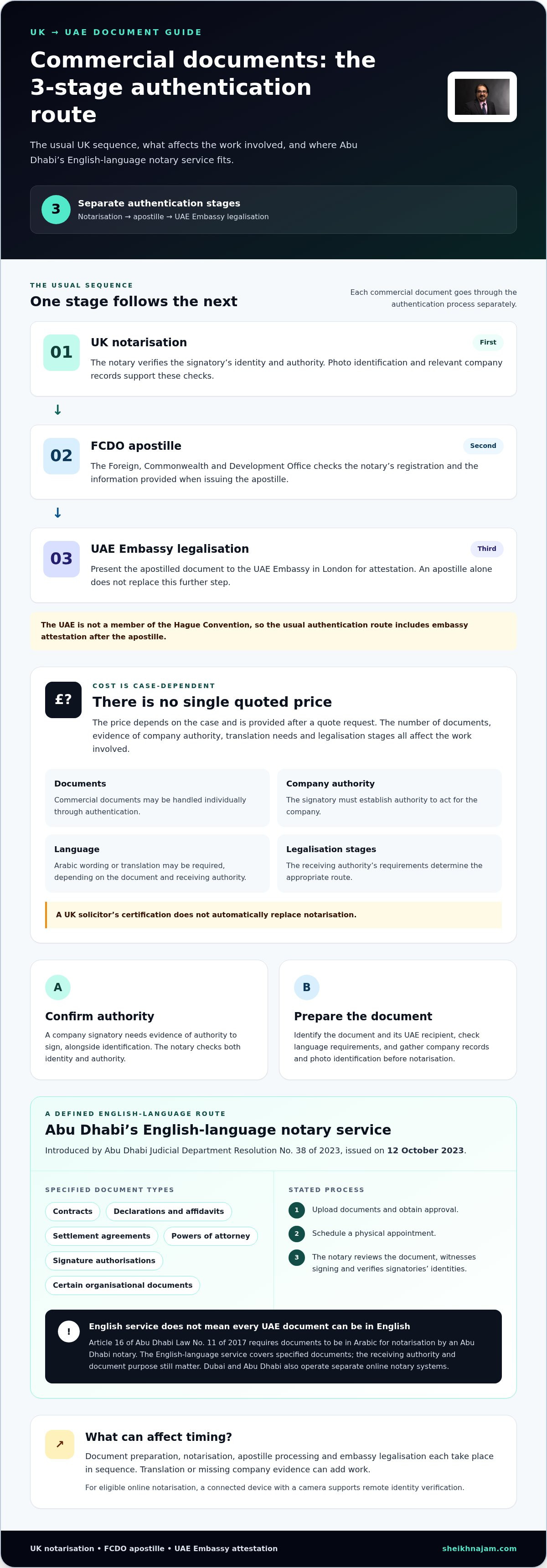
The cost of preparing UK commercial documents for use in the UAE depends on how many documents need attention and which authentication stages are required. Commercial documents may need to be handled individually for use in the UAE. UK documents intended for the UAE usually require notarisation, an apostille and legalisation by the relevant embassy. The price depends on the case and is provided after a quote request.
A company signature involves more than witnessing a name on a page: the signatory must have authority to act for the company, supported by appropriate documents and identification. Choosing a notary for documents to be used in the UAE therefore means considering both the document’s purpose and the formalities it must meet.
This guide explains the factors that shape the process and its cost, including the requirements for powers of attorney, affidavits and acknowledgements. It also shows how wording, signing authority and the order of authentication affect the steps required, helping you prepare for a UAE transaction.
Table of Contents
How much does it cost to notarise commercial documents for the UAE?
The cost depends on the documents, signatures and authentication stages involved. Commercial documents may be handled separately during the authentication process. The price depends on the case and is provided after a quote request. The number of documents, evidence of company authority, translation needs and legalisation stages all affect the work involved.
A UK solicitor’s certification does not automatically replace notarisation. UK documents intended for use in the UAE usually require notarisation, an apostille and legalisation by the relevant embassy. The receiving authority’s requirements determine the appropriate route.
Requirements vary according to the document’s purpose and the authority receiving it. Personal, business, court and visa documents may call for different evidence, wording or authentication. For applicants coordinating family relocation or visa paperwork, government service specialists such as Goodhand can help clarify which attested documents local departments require. Commercial signatories must also establish their authority to act for the company.
For a UK document intended for the UAE, the usual sequence is UK notarisation, an apostille issued by the Foreign, Commonwealth and Development Office, then legalisation by the UAE Embassy in London. The UAE is not a member of the Hague Convention, so an apostille alone does not replace the further embassy attestation.
When issuing an apostille, the Foreign, Commonwealth and Development Office checks the notary’s registration and the information provided. The apostilled document is then presented to the UAE Embassy in London for attestation. Each commercial document goes through this process separately.
Prepare the document and supporting evidence before arranging notarisation. A company signatory needs to show authority to sign, along with identification. The notary verifies the signatory’s identity and authority; photo identification and relevant company records support these checks. For eligible online notarisation, a connected device with a camera supports remote identity verification.
Identify each document and its intended recipient in the UAE.
Gather the signatory’s photo identification and evidence of company authority.
Establish whether the document requires Arabic wording or translation.
Allow for separate notarisation and legalisation of each commercial document.
Language can affect the preparation. Article 16 of Abu Dhabi Law No. 11 of 2017 requires documents to be in Arabic for notarisation by an Abu Dhabi notary. Abu Dhabi also has an English-language notary service for specified documents, addressed in the next section.
Timing depends on document preparation, notarisation, apostille processing and embassy legalisation. Each stage follows the previous one, and translation or missing company evidence can add work. For a notary for documents to be used in the UAE, the process depends on the document type, destination emirate and signatory’s capacity.
The UAE Embassy in London attests UK documents after the apostille stage. Present the apostilled document for embassy legalisation, and have relevant supporting records and identification ready for notarisation. An apostille without the required UAE Embassy attestation may leave the document short of the usual authentication sequence.
Those additional charges mean the quoted legalisation figure should not be treated as the full amount payable for the complete authentication process.
Abu Dhabi’s English-language notary service
Abu Dhabi introduced an English-language notary service through Abu Dhabi Judicial Department Resolution No. 38 of 2023, issued on 12 October 2023. It provides a defined route for specified documents drafted in English, rather than making Arabic the only language available for every notarial act in Abu Dhabi.
Article 3 states that the new office’s procedures, processes and forms are exclusively in English. This concerns the service’s administration; it does not mean every document prepared for every UAE authority can be in English. The receiving authority and the document’s purpose remain central when determining language and subsequent formalities.
Article 5 identifies the documents that the English-language service can attest. These include contracts, declarations and affidavits, settlement agreements, powers of attorney, signature authorisations and certain organisational documents. A company preparing a signature authorisation, for example, can consider whether that document falls within this stated scope.
The service is relevant to individuals, families and businesses whose documents need use in the United Arab Emirates, Qatar, Saudi Arabia or other destinations. Its establishment in Abu Dhabi does not make it a single system for all emirates: Dubai and Abu Dhabi operate separate online notary systems, and requirements can vary by destination and document.
Article 4 allows licensed private or government notaries to provide the English-language service, subject to a separate direction from Abu Dhabi Judicial Department’s Private Notary Affairs Committee. That distinction matters when identifying the authority responsible for a particular notarial act. A notary’s general licence alone does not describe the full procedural basis stated in the resolution.
Abu Dhabi’s online notary process follows a defined sequence: documents are uploaded and approved before a physical appointment is scheduled. The UAE notary reviews the document, witnesses its signing and verifies the signatories’ identities. Prepare the final text and identification before the appointment.
English-language notarisation of commercial documents does not remove the need to establish a signatory’s authority. Nor does it replace the separate UK apostille and UAE Embassy legalisation stages when required for use in the UAE. Notarisation, translation and embassy formalities serve different purposes.
Identify the receiving emirate and authority before selecting the process.
Match the document to Article 5’s listed categories.
Prepare the final document and signatory identification for review.
Allow for the separate authentication stages required for the document’s destination.
For guidance on preparing documents for a UAE notarial process, discuss your notarial requirements before finalising execution arrangements.
The service is expected initially to be available only to Abu Dhabi residents and companies. In Abu Dhabi, a notary public is approved or licensed by the Judicial Department to notarise customary documents. Abu Dhabi notaries notarise documents in accordance with the law or at an applicant’s request.
Applicants can choose local face-to-face assistance or e-notarisation and e-apostille. The notary service also offers to arrange document translation, legalisation and notarisation on the same day. Applicants can consider which form of assistance they need and whether the same-day arrangement suits their document and intended use.
Notarisation of powers of attorney
A power of attorney authorises another person to act within the powers set out in the document. For use in the United Arab Emirates, it should identify the authorised representative and describe the permitted acts. For example, a document authorising company representation should make that authority clear. The receiving organisation’s requirements influence the form and supporting evidence needed.
Abu Dhabi’s English-language notary service expressly covers powers of attorney. Article 5 of Abu Dhabi Judicial Department Resolution No. 38 of 2023 includes them among the documents eligible for English-language attestation. This route may be relevant where an English document is intended for use in Abu Dhabi, subject to the service’s procedures and the document’s purpose.
Duration is another important drafting consideration. Abu Dhabi notaries typically limit powers of attorney to a maximum of two years. Dubai more commonly accepts powers of attorney that exceed the two-year maximum typically permitted by Abu Dhabi notaries. The destination emirate therefore matters when preparing a document, particularly if the authority needs to remain in place for an extended period.
Before signing in the UK, settle the document’s wording and identify everyone who will execute it. A notary public verifies the signatory’s identity and witnesses the signing. A company representative must also provide evidence of authority to sign for the company. Have identification and relevant corporate records ready for the appointment.
The UK notarial act is one stage of preparation, not the complete authentication process. UK documents intended for use in the UAE usually need notarisation, an apostille and legalisation by the relevant embassy. Commercial documents may need to be prepared and authenticated individually. If a power of attorney forms part of a wider company transaction, coordinate its wording and execution with the other documents, while keeping in mind that they are not legalised as one bundle.
Define the representative’s authority and the actions it covers.
Identify the destination emirate and consider Abu Dhabi’s typical two-year limit.
Prepare photo identification and company-authority evidence before signing.
Plan for the document’s apostille and relevant embassy legalisation after notarisation.
If the power of attorney will instead be signed before a UAE notary public, all signatories must be physically present. This differs from UK notarisation: signing arrangements depend on where the notarial act takes place. Confirm the intended use, recipient and emirate before execution so the document’s language, duration and authentication sequence suit its purpose.
Affidavits and acknowledgements
An affidavit records a person’s sworn or affirmed statement of facts. An acknowledgement records that person’s acknowledgement of a document or signature. For UAE use, the distinction matters because the receiving authority may require a particular document type, wording or execution method. First identify the purpose, such as confirming a fact or formally acknowledging a signature.
Ideally, a UK notary witnesses the signing of the document being authenticated. Arrange the appointment before signing, and bring the final document and photo identification. If the affidavit contains a statement, read it carefully before making it: witnessing the signing does not establish that its contents are true.
For an acknowledgement, ensure that the document presented is the version intended for use. In a commercial transaction, check that the signatory’s name and capacity are stated consistently throughout. A company representative signing on the company’s behalf needs identification and supporting evidence of authority.
Abu Dhabi’s English-language notary service expressly includes declarations and affidavits under Article 5 of Abu Dhabi Judicial Department Resolution No. 38 of 2023. This provides a specific English-language route for those document categories in Abu Dhabi. The resolution also lists contracts, settlement agreements, powers of attorney, signature authorisations and certain organisational documents.
Language and destination require attention. Article 16 of Abu Dhabi Law No. 11 of 2017 requires documents to be in Arabic for notarisation by an Abu Dhabi notary. The English-language service is a distinct procedure; identify the relevant authority and document category before settling the text. A dual-language document may also need careful alignment between its versions.
For a UK document intended for use in the UAE, notarisation is generally followed by an apostille and relevant embassy legalisation. The apostille authenticates the notarial act, while the signatory remains responsible for the document’s statements. An apostille alone does not replace UAE Embassy attestation when that further stage is required.
Confirm whether the recipient requires an affidavit, declaration or acknowledgement.
Use the recipient’s required wording and prepare the final document before signing.
Bring photo identification and, for company signatories, evidence of signing authority.
Plan the UK notarisation and subsequent authentication stages for each document.
These steps distinguish the act witnessed by the notary from the document’s substantive contents. For example, a notary can witness an affidavit’s execution, but the person making the statement remains responsible for it. Careful preparation also allows the receiving UAE authority’s requirements to guide the document’s form, language and authentication route.
Where can I find a notary in the UK for documents to be used in the UAE?
Start with the document’s destination and intended use, then arrange a UK notarial appointment before signing. A notary public can verify the signatory’s identity and witness execution. For company documents, prepare evidence that the person signing has authority to act for the company. These details help establish what notarial act is required.
At an in-person appointment, the notary can inspect identification and witness the signature directly. Bring the final document and relevant supporting records, such as evidence of company authority. If the document is an affidavit, arrange to sign it before the notary, who ideally witnesses the execution of the document being authenticated.
Eligible documents can also be processed entirely online through e-notarisation and e-apostille, without posting physical paperwork. This route depends on the document being eligible for electronic processing. A connected device enables the remote appointment, while the notary still verifies the signer’s identity and witnesses the required act.
Before the appointment, establish whether the document is intended for Abu Dhabi or another emirate. Abu Dhabi’s English-language notary service covers specified categories, including powers of attorney, declarations and affidavits. 11 of 2017 requires documents to be in Arabic for notarisation by an Abu Dhabi notary, making the language route a key preparation point.
For UK documents destined for the UAE, the notarial act is followed by an apostille issued by the Foreign, Commonwealth and Development Office, then legalisation by the UAE Embassy in London. The sequence matters: the apostille authenticates the notarial act, while embassy legalisation provides the further attestation for UAE use. Each commercial document is processed separately.
When arranging the appointment, have the document’s recipient, purpose and final wording ready. A power of attorney for a business transaction, for example, may require evidence of company authority. Someone making an affidavit must understand and make the statement. These distinctions help identify the required notarial act, supporting records and signing arrangements.
Set out the destination emirate and the document’s intended use.
Prepare the final document, photo identification and any authority evidence.
Choose an in-person appointment or eligible online processing.
Allow for the FCDO apostille and UAE Embassy legalisation after notarisation.
For assistance arranging UK notarisation for UAE-bound documents, discuss your notarial requirements.
Sheikh Najam TEP: Notarial Services
Sheikh Najam TEP provides Notarial & Cross-Border Legal Services for individuals and businesses preparing documents for use in the UAE. The service is relevant when a commercial document, power of attorney, affidavit or acknowledgement requires UK notarisation as part of its authentication process.
Careful preparation starts with the document’s purpose, the receiving authority and the signatory’s capacity. For company documents, evidence of signing authority supports the notarial process. For personal documents, the required form and execution should reflect the intended use. This approach helps identify issues to resolve before signing and subsequent legalisation.
Where a matter also involves succession or asset arrangements, related Trust and Estate Planning may be relevant alongside the document work. For assistance with your UAE-bound documents, contact Sheikh Najam TEP.
Prepare your next step with precision
Before execution, align the document’s purpose, intended recipient and proposed wording. This gives the notary a clear context for the required act and helps identify questions about signing authority or the document’s wider commercial or personal role. Choosing a notary for documents to be used in the UAE is therefore part of preparing the transaction, not an isolated formality.
Sheikh Najam TEP provides Notarial & Cross-Border Legal Services and can also advise on Private Wealth & Succession or International Corporate Tax & Structuring where cross-border documents form part of wider asset, succession or business arrangements. These matters benefit from considering the document alongside the affairs it is intended to support.
To discuss your document and the appropriate next step, contact Sheikh Najam TEP. With the purpose and recipient clearly identified, you can proceed with greater confidence.
Frequently Asked Questions
How much do UK notary, apostille, and UAE document attestation services cost?
The total cost depends on the document, signing arrangements and authentication stages required. Each commercial document is processed separately, so a company submitting several documents should account for separate handling. Translation requirements and supporting evidence, such as proof of a signatory’s authority, can also affect the work involved. Notarial service pricing depends on the case and is provided after a quote request.
Do documents for the UAE need to be translated into Arabic or certified?
It depends on the document’s destination and the authority receiving it. 11 of 2017 requires Arabic documents for notarisation by an Abu Dhabi notary, while Abu Dhabi also has an English-language service for specified documents. For example, Article 5 includes affidavits and powers of attorney. Ask the recipient which language and document form it accepts before finalising the text.
How long does UK notarisation and UAE legalisation take?
Timing depends on document preparation, notarisation, apostille processing and UAE Embassy legalisation, which must be completed in sequence. Translation or missing evidence of company authority can add work.


Comments