Setting Up a Bare Trust for a Child: Roles and Trust Deed

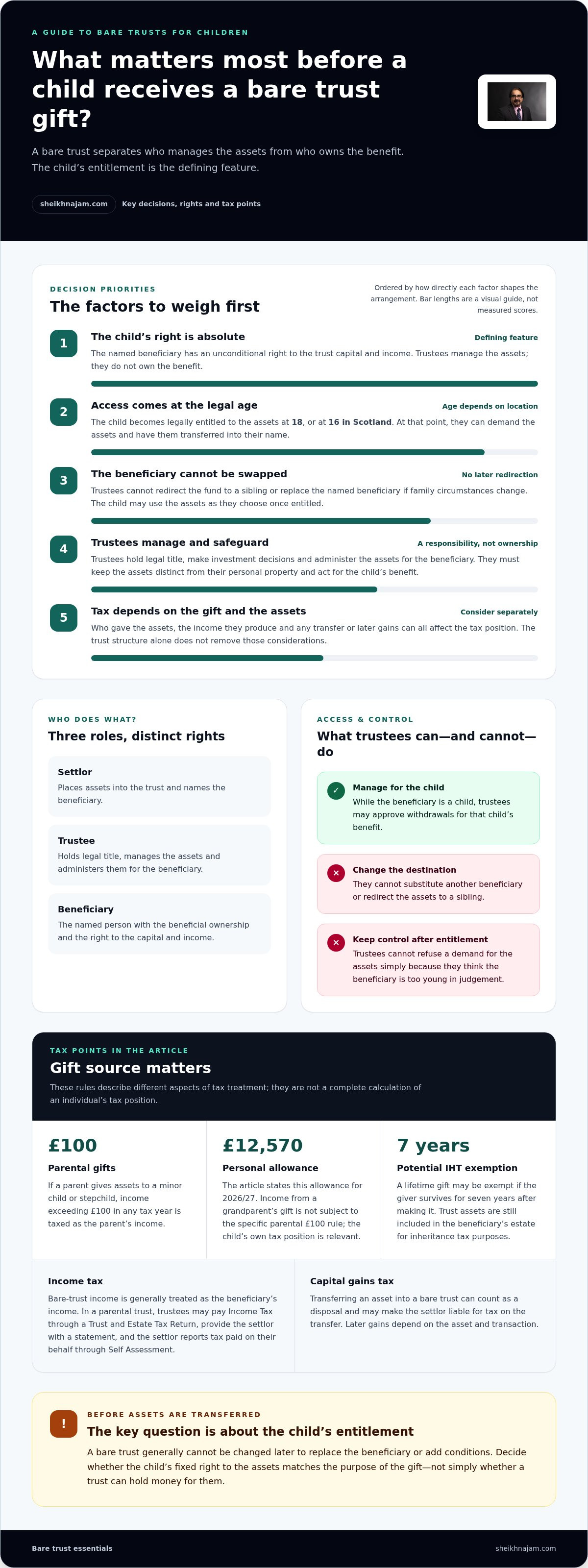
A gift to a child can belong to them in law before they are old enough to manage it. In a bare trust, trustees hold and manage assets for the child, who has an absolute right to the trust capital and income; according to the UK Government, the child becomes legally entitled to the assets at 18, or at 16 in Scotland. Setting up a bare trust for a child therefore involves more than choosing who will look after the money: the child’s entitlement is fundamental to the arrangement.
It’s understandable to see a trust as a way to control when a child receives a gift. A bare trust generally does not offer that flexibility, so understand the roles and consequences before transferring assets. This article explains what a bare trust is, what the settlor, trustees and beneficiary each do, and how it compares with child savings options, including Junior ISAs and Junior SIPPs.
You’ll also learn what a trust deed records, how trustees can manage assets for a child’s benefit, and what to consider when choosing this structure. The key question is whether the child’s immediate beneficial entitlement matches your intentions, not simply how to hold money for them.
Table of Contents
What is a bare trust?
A bare trust holds assets for a named beneficiary, who owns the beneficial interest outright. Trustees manage the property, but the beneficiary has an absolute right to its capital and income, without having to meet conditions. Before setting up a bare trust for a child, consider whether this fixed entitlement suits the gift’s purpose. Trustees cannot later redirect the assets to another beneficiary.
Tax treatment depends partly on who made the gift and what income the assets produce. If a parent gives assets to their minor child or stepchild, income exceeding £100 in any tax year is taxed as the parent’s income. This rule can apply when the gift is held in a bare trust, so the trust structure alone does not prevent parental income attribution.
Income from bare-trust assets is generally treated as the beneficiary’s income. A gift from grandparents is not subject to the specific parental £100 rule, so the child’s own tax position is relevant. For 2026/27, the personal allowance is £12,570. For example, if grandparents give a child investments that produce income, the income is assessed as the child’s, subject to the applicable tax rules and the child’s other income.
Investment income and capital growth have separate tax implications. In a parental trust, trustees may pay Income Tax on trust income through a Trust and Estate Tax Return, provide the settlor with a statement of income and tax charged, and the settlor reports tax paid on their behalf through Self Assessment. Separately, transferring an asset into a bare trust can count as a disposal for capital gains tax, potentially making the settlor liable for tax on the transfer. Later gains depend on the asset and transaction.
Inheritance tax also requires separate consideration. Creating a bare trust with a lifetime gift does not itself trigger an inheritance tax charge. HM Revenue & Customs states that a gift may be exempt if the giver survives for seven years after making it. The trust assets are still included in the beneficiary’s estate for inheritance tax purposes, so the donor’s estate and the child’s future estate are separate parts of the analysis. The tax consequences of setting up a bare trust for a child should therefore be considered alongside the gift’s intended purpose.
The cost of setting up and managing a bare trust in the UK depends on the case and is given after a quote request. Relevant factors include the deed’s complexity, the assets involved and any associated tax work.
Bare trust definition and roles of settlor, trustee and beneficiary
A bare trust separates legal management from beneficial ownership: trustees hold assets for one named beneficiary. The settlor’s choices matter because the beneficiary’s entitlement is fixed, not discretionary.
Settlor, trustee and beneficiary roles
The settlor places assets into the trust and names the beneficiary entitled to them. A parent might settle cash or investments for a child, making that child the sole person who can benefit. Trustees hold legal title, make investment decisions and administer the assets for the beneficiary. A bare trust can have one or more trustees, but their management role does not give them beneficial ownership.
This division affects both control and responsibility. The settlor should clearly identify the child and specify which assets are being transferred. Trustees must keep assets held for that child distinct from their personal property and act for the beneficiary’s benefit. They cannot redirect the fund to a sibling or substitute another beneficiary, even if family circumstances change.
Beneficiary entitlement and access
A child beneficiary has an absolute right to the trust capital and income, without having to meet conditions. According to the UK Government, a child is legally entitled to bare-trust assets at age 18, or age 16 in Scotland. The rules in England, Wales and Northern Ireland therefore differ from Scotland’s age of entitlement.
Trustees manage the assets while the beneficiary is a child and may approve withdrawals for that child’s benefit. Once the applicable age is reached, the beneficiary can demand the assets and their transfer into their name. Trustees cannot refuse simply because they consider the beneficiary too young in judgement or prefer to keep the assets invested.
Choosing the asset and naming the child are consequential steps. A trust may hold cash, shares or other property, but the transfer must identify what is held and for whose benefit. For example, if grandparents transfer investments for one grandchild, that grandchild becomes the beneficiary; other grandchildren gain no entitlement under that bare trust. The beneficiary cannot later be changed to reflect a new family preference.
The principal disadvantage is losing control over where the capital goes and when. At the relevant age, the child may use the assets as they choose, rather than for education or housing. This differs from a discretionary arrangement, where trustees decide which beneficiaries receive assets. Trustees also have administrative and investment responsibilities, and a breach of those duties may expose them to a claim.
A bare trust generally cannot be changed to replace its beneficiary or impose new conditions after the gift. It ends when the assets are transferred to the beneficiary or otherwise dealt with under the trust terms. If the beneficiary dies, the assets form part of their estate and pass under their will or the applicable succession rules. That consequence makes the named beneficiary and the trust’s purpose central decisions.
Where the proposed gift raises questions about control, succession or family arrangements, discuss the trust structure and its implications before transferring assets.
Bare trusts compared with Junior ISAs and Junior SIPPs
These arrangements differ in ownership, access and purpose. A bare trust gives a named child beneficial ownership of its assets, while a Junior ISA or Junior SIPP holds savings within a specific account structure. The choice depends on whether flexibility, tax treatment, investment purpose or control at adulthood matters most.
A Junior ISA offers a defined savings framework. HM Revenue & Customs states that parents can save up to £9,000 annually in a Junior ISA. The child cannot access the account, and it becomes theirs at age 18. By comparison, a bare trust has no limit on the value of assets it can hold, but its beneficiary has an absolute entitlement. That can suit a substantial gift, yet it does not let trustees delay the child’s right to the assets.
Combining arrangements can serve different purposes. A family might use a Junior ISA for savings intended to remain inaccessible until adulthood, while holding other assets in a bare trust. The Junior ISA allowance applies to contributions into that account, not to the value of a separate bare trust. Trustees should keep records distinguishing each child’s account, trust property and contributions, rather than treating them as one fund.
A Junior SIPP is designed for long-term pension saving, not general spending when a child reaches adulthood. The two arrangements serve different purposes, and a bare trust gives its beneficiary rights to the trust assets and income. Consider the intended use of each contribution: education or early-adult costs may call for different planning from retirement provision. Pension rules govern access to a Junior SIPP, rather than the trust’s terms.
Child Trust Funds are relevant where a child already has one. Compare its account terms and investment purpose with a Junior ISA before deciding how further savings should be arranged. A bare trust can exist alongside an account-based option, but the records should identify who owns each asset and who can give instructions. A bare-trust beneficiary’s entitlement generally arises at 16, whereas Junior ISA access is at 18.
A Junior GIA is an investment-account description, not a substitute for examining the legal ownership arrangement. Establish whether the account holds assets for the child under a bare trust, who is named as beneficiary, and who can make investment decisions. The account’s tax treatment follows its ownership and structure; an account label alone does not make its investments exempt from tax.
A bare trust may offer trustees some flexibility in managing investments, but the beneficiary’s entitlement is not conditional. Account-based options have their own contribution and access frameworks. Compare the intended recipient, withdrawal timing and investment purpose before transferring money, then register and document each arrangement according to its applicable requirements.
Drafting and signing a trust deed
A trust deed records how the bare trust is established and identifies the property held for the child. It should state the settlor’s intention, name the beneficiary and trustees, describe the assets, and explain how trustees hold and administer them on the child’s behalf. Setting up a bare trust for a child means ensuring the deed reflects the actual asset transfer, not merely a future intention to make a gift.
A deed is not always required to establish a bare trust. The settlor may instead make a declaration of trust, recording that specified assets are held for the named child. Unlike an informal understanding, written evidence can help trustees, family members and an account provider understand the intended ownership. For example, a declaration could identify shares transferred to trustees for one child and confirm that the child is the beneficiary.
Before signing, accurately identify each trustee and beneficiary, then clearly describe the assets. One trustee is the minimum, although two trustees are recommended. Trustees make investment decisions and remain legally responsible for proper administration. The settlor and trustee should both sign the deed in the presence of a witness. This creates a clear record of who agreed to the arrangement and when it was executed.
To open a bare trust account, prepare the child’s identifying details, the settlor’s and trustees’ details, a description of the assets, and the deed or declaration. A bank or investment platform will also require account-opening information and identification for relevant people. Keep transfer records and account statements to show which assets became trust property and when the transfer occurred.
A bank or investment platform can provide an account for trustees to hold cash or investments, but the account itself does not establish the trust’s terms. A solicitor can prepare or review the deed, while the financial institution handles account opening and asset custody. These are distinct functions: the deed defines the arrangement, and the account holds particular assets for the beneficiary.
If no deed exists, evidence may include the settlor’s written declaration, transfer documents, account records and correspondence identifying the child as beneficiary. Together, these documents can record the settlor’s intention and which assets were transferred. When setting up a bare trust for a child, consistent records help distinguish an outright gift from an arrangement subject to conditions.
Registration is separate from signing the deed or opening an account. According to HM Revenue & Customs, new bare trusts will normally need registration with the Trust Registration Service within 90 days of being set up. Some bare trusts holding assets that will not produce income are exempt. Trustees should consider whether registration applies and retain records of the decision.
Where the deed must coordinate family intentions, asset transfers and trustee responsibilities, discuss the trust documentation before execution.
Bare trusts as a way to hold assets for children
A bare trust can hold money or investments for a child while trustees manage them. Its practical value is the separation between the child’s beneficial ownership and the trustees’ day-to-day administration. For example, a grandparent could place £10,000 into a trust for one grandchild, with trustees managing the investment until the child can take control.
This structure can suit a gift intended for a particular child, rather than a pool that adults may allocate among family members. The beneficiary is identified from the outset, and the assets belong beneficially to that child. If family circumstances change, trustees cannot simply redirect the fund to a sibling or another relative. This fixed entitlement is central to deciding whether the arrangement fits the gift.
Trustees can manage assets for the child’s benefit before the child reaches the applicable age of entitlement. They may use trust money for the child’s needs, subject to their responsibilities and the trust’s terms. For instance, trustees could consider a withdrawal for the child’s education or another direct benefit. They must act for that beneficiary, rather than treating the fund as a general family resource.
A bare trust can also hold multiple accounts for different purposes. Trustees might keep one account for cash and another for investments, while maintaining clear records that both belong to the same child. Separate records help distinguish trust assets from a trustee’s own funds and show how contributions, income and withdrawals relate to the child’s property.
Investment decisions affect what the child ultimately receives. Trustees may choose to hold cash, shares or other suitable assets, but the trust does not remove investment risk. If investments fall in value, the child’s capital may reduce; if they grow, the resulting assets remain beneficially theirs. The trustees’ role is to administer the property for the child, not guarantee a particular outcome.
Consider the estate consequences as well as the intended benefit. Assets in a bare trust form part of the beneficiary’s estate for inheritance tax purposes. The child’s absolute entitlement also means they may use the assets for any purpose after gaining control. A donor seeking to direct how funds are spent, or who ultimately benefits, may need to compare this structure with a discretionary trust, where trustees have discretion over distributions.
The key decision is whether a direct, irrevocable benefit for one named child matches the gift’s purpose. If it does, define the assets, beneficiary and trustees clearly before transferring property. If control over timing or recipient matters more, a bare trust may not provide the required flexibility. Discuss the trust structure for a child’s assets before making the transfer.
Sheikh Najam TEP: Notarial Services
Sheikh Najam TEP provides Notarial Services and Trust and Estate Planning for matters involving a child’s trust. Notarial support may be relevant when trust documents require notarisation, while trust and estate planning can help assess whether the proposed arrangement aligns with the family’s intentions and succession plans.
Where a gift may affect the donor’s estate, Inheritance Tax Planning can form part of the wider assessment. Key issues include who will benefit, which assets are being transferred, and whether the child’s absolute entitlement fits the intended purpose. Advice is particularly relevant where the trust forms part of broader family or cross-border arrangements.
Contact Sheikh Najam TEP to discuss the trust, its documentation and its place within your estate planning.
Make the next decision with clarity
Before setting up a bare trust for a child, define the gift’s purpose and how much control you are prepared to relinquish. Consider the trust within the family’s wider estate arrangements, rather than treating the transfer as an isolated transaction. This can help align the chosen structure with future succession intentions and the responsibilities of those administering the assets.
Sheikh Najam TEP provides Trust and Estate Planning and Inheritance Tax Planning for families assessing these connected issues. Its Notarial Services may also be relevant when documents require notarial attention. Support can range from considering the proposed arrangement to addressing documentation within a broader estate plan.
Contact Sheikh Najam TEP to discuss your trust and estate planning. A considered next step can help you proceed with greater confidence and a clear understanding of your intentions.
Frequently Asked Questions
How do I register the trust?
Trustees register a bare trust with HMRC’s Trust Registration Service, where registration is required. HMRC states that new bare trusts will normally need registration within 90 days of being set up. Some bare trusts holding assets that won’t produce income are exempt. Trustees should retain the registration details and records supporting the trust’s structure, then update the register within 90 days of relevant reportable changes, such as a change to beneficiaries.
How much control do I have over how the trust is used?
As settlor, you decide the initial gift and identify the child who will benefit, but you cannot retain unrestricted control over the assets. Trustees administer and invest the fund for that child; they may approve expenditure for the child’s benefit before the age of entitlement. For example, they could consider paying a school-related cost from the trust. They cannot redirect the assets to another child or impose new conditions after the transfer.
What is a trust for a child?
A trust for a child is an arrangement in which trustees hold property for the child’s benefit, rather than the child managing it directly. The child is the beneficiary, while trustees administer the assets under the trust’s terms. The structure can be bare, interest in possession, accumulation or discretionary. “Parental trust” describes a trust created by parents for a child, rather than a separate legal type of trust.
What is a bare trust for a child in the UK?
A bare trust for a child is a trust where the child is the sole person entitled to benefit from its assets. Trustees hold legal title and administer the property, but the child owns the beneficial interest outright. This differs from arrangements where trustees can choose among beneficiaries or impose conditions on distributions. The distinction matters if the family wants the child to own the gift, rather than merely have a possible future benefit.
How do you set up a bare trust for a child in the UK?
First identify the child, the assets and the trustees, then record the settlor’s intention in a trust deed or declaration. Transfer the assets so the records show that trustees hold them for the child, and retain account and transfer documents. For example, investment statements should distinguish trust holdings from trustees’ personal investments. Trustees should also determine whether registration applies and complete any required Trust Registration Service filing.
Who can be a trustee and beneficiary of a bare trust?
The settlor appoints one or more trustees to hold and administer the assets; the beneficiary is the named child entitled to them. A bare trust has one beneficiary, so it does not allow trustees to divide the fund between siblings according to later circumstances. When choosing trustees, consider who can make careful investment and administration decisions and keep clear records. The beneficiary’s identity should be stated precisely in the trust documents.
What are the UK tax rules for bare trusts, including income tax, capital gains tax and inheritance tax?
Tax depends on who made the gift and what the assets generate. Income from bare-trust assets is generally treated as the beneficiary’s income, but income above £100 in any tax year from a parent’s gift to a minor child or stepchild is taxed as the parent’s. Transferring an asset can count as a disposal for capital gains tax, potentially making the settlor liable. A lifetime gift has no inheritance tax charge when the trust is created; inheritance tax treatment also involves the donor’s survival and the beneficiary’s estate.
How does a bare trust compare with a Junior ISA or a discretionary trust?
A Junior ISA has a contribution limit and prevents access by anyone other than the child before adulthood; a bare trust has no limit on the value of assets it can hold. HM Revenue & Customs states that parents can save up to £9,000 per year in a Junior ISA. Unlike a bare trust, a discretionary trust gives trustees discretion over who benefits and when. The choice turns on ownership, access and the degree of control intended.



Comments