London Non-Dom Tax: Strategic Mitigation Post-2026

Updated: Aug 26
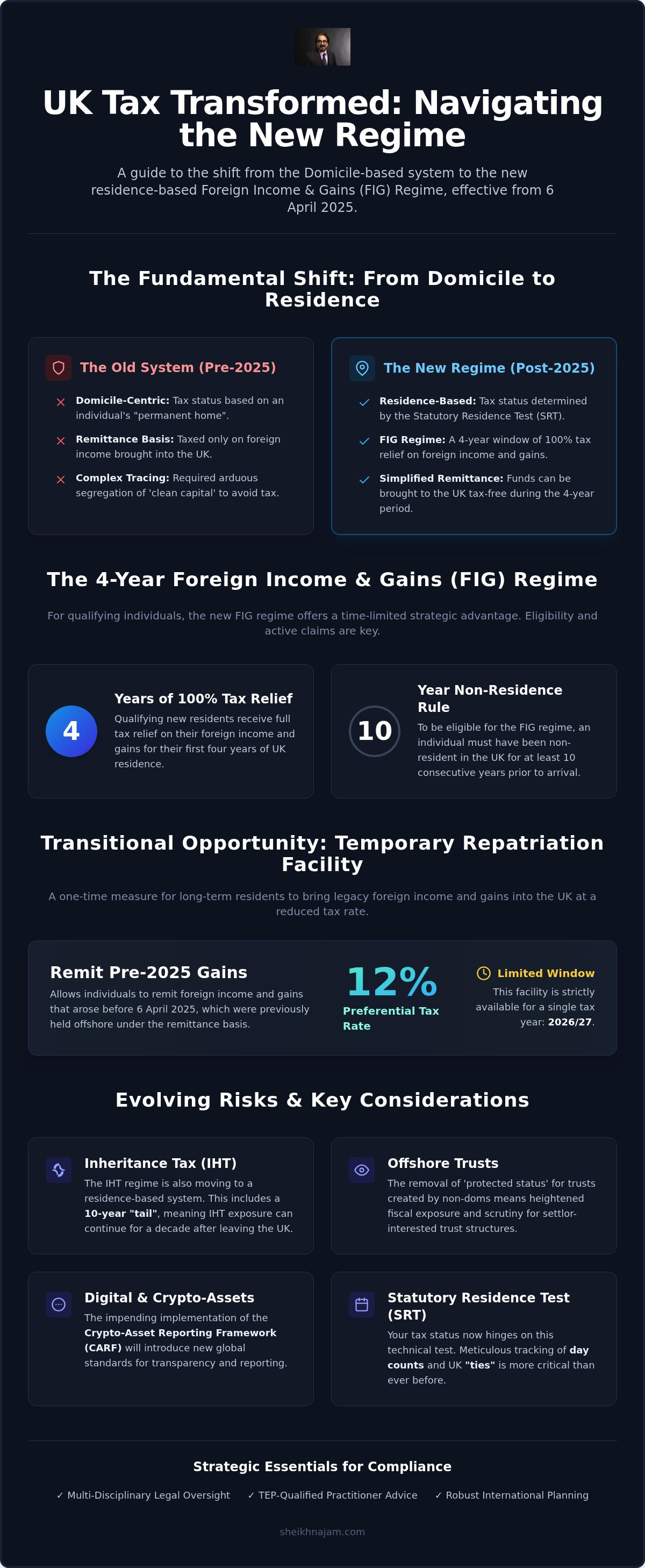
The definitive abolition of the remittance basis on 6 April 2025 has signaled a profound shift in the fiscal architecture of the City, rendering legacy domicile-based planning obsolete for the modern international elite. For those addressing the complexities of non-dom income tax London, the transition from a domicile-centric model to the residence-based Foreign Income and Gains (FIG) regime requires more than mere compliance; it demands a sophisticated, multi-disciplinary strategy to safeguard global assets. You're likely aware that the previous certainties of offshore shielding have been replaced by a rigorous four-year eligibility window and a ten-year inheritance tax tail. It's a landscape where fiscal exposure is determined by the meticulous precision of one's residency status.
This comprehensive analysis offers a scholarly examination of the strategic mitigation techniques available under the new regime, including the Temporary Repatriation Facility which permits the remittance of pre-2025 gains at a 12% rate during the 2026/27 tax year. We'll investigate the mechanics of the FIG exemption, the evolving scrutiny of settlor-interested trusts, and the critical role of the Statutory Residence Test in maintaining wealth mobility. By deconstructing these regulatory pivots, this discourse provides the clarity necessary to transition your affairs into the residence-based era whilst ensuring that your worldwide income remains shielded from unnecessary double taxation.
Table of Contents
The 2026 Landscape: Navigating London Post-Abolition of the Non-Dom Regime
The structural transformation of the UK taxation system has reached a critical maturity in 2026, marking the end of the domicile-based era that once defined the fiscal experience of the global elite in London. This seismic shift from the legacy remittance basis to the Foreign Income and Gains (FIG) framework represents a move towards jurisdictional transparency and residence-based accountability. For high-net-worth individuals, the ambiguity surrounding a "permanent home" has been superseded by the technical rigour of the Statutory Residence Test (SRT). Managing non-dom income tax London now requires a forensic understanding of these legislative pivots; inertia is no longer a neutral stance but a direct path to unintended global tax exposure.
From Domicile to Residence: A Fundamental Shift
The transition signifies that your "domicile of origin" or "domicile of choice" no longer functions as the primary determinant for UK income tax liability. Instead, the focus has shifted entirely to tax residence, specifically under the new FIG regime which requires a strict 10-year period of non-UK residence as a pre-requisite for eligibility. For the incoming executive or investor, this four-year window of 100% relief on foreign income and gains offers a clear, albeit time-limited, strategic advantage. Despite these more stringent parameters, the City of London maintains its status as a pre-eminent global hub. Its appeal is now rooted in the clarity of its regulatory environment and the sophisticated legal architecture that supports complex, cross-border wealth structuring within a highly organised residence-based framework.
The Legacy of the Remittance Basis in 2026
For long-term residents who previously utilised the remittance basis, 2026 is a year of meticulous reconciliation. Managing unremitted income and gains that accrued prior to 6 April 2025 demands an exacting approach to historical record-keeping, particularly when dealing with segregated accounts that must withstand HMRC scrutiny. The complexity of these legacy structures highlights the necessity for precise notarial authentication and expert multidisciplinary oversight. The Temporary Repatriation Facility (TRF) functions as a crucial transitional mechanism, allowing individuals to remit foreign income and gains that arose before the 2025 reforms at a preferential tax rate of 12% throughout the 2026/27 tax year. Success in this new era depends upon the ability to deconstruct these legacy positions whilst simultaneously aligning with the new residence-based obligations.
The FIG Regime: Optimising the Four-Year Fiscal Window
The Foreign Income and Gains (FIG) regime, established as the successor to the remittance basis, offers a precisely defined four-year window for high-net-worth individuals to establish their presence in the City without immediate exposure to worldwide taxation. For those managing non-dom income tax London liabilities, this regime provides 100% relief on qualifying foreign income and gains, provided the individual has maintained a ten-year period of non-UK residence prior to arrival. Unlike the predecessor system, which required the arduous segregation of "clean capital" to avoid tax on remittances, the FIG framework permits the tax-free movement of funds into the UK. This creates a more fluid environment for capital deployment whilst maintaining a rigorous boundary between domestic and international wealth. Consistency in making an annual claim is paramount to preserving this status throughout the eligibility period.
Structuring Global Income for New Arrivals
Under the 2026 protocols, the identification of qualifying foreign income requires meticulous classification. The FIG regime allows for the total exemption of foreign earnings and investment returns, which can be brought to the UK without triggering the complex tracing rules that once plagued the remittance basis. This transparency is a cornerstone of the UK Government's 2025 Non-Dom Tax Reforms. International trusts established within this four-year window must be structured with precision to ensure that the settlor's status remains compliant with the evolving FIG eligibility requirements, particularly regarding the annual claim process and the management of trust distributions.
The Transition to Worldwide Taxation
As the "Year Five" cliff edge approaches, the strategic focus must shift from temporary relief to long-term wealth preservation. Pre-emptive measures include evaluating the benefits of rebasing assets to their April 2019 values, a transitional provision designed to mitigate capital gains tax exposure on assets held before the regime change. Navigating this transition requires the multidisciplinary expertise of a private client solicitor London who can coordinate the interplay between trust law and residence-based taxation. Establishing these long-term fiscal structures well in advance of the fifth year is essential to prevent a sudden and significant increase in global tax liability. For those seeking to preserve multi-generational wealth, engaging in international tax planning at the outset of the FIG period is a prerequisite for sustained financial security.
Transitional Protections and the Statutory Residence Test
The abolition of domicile as a primary tax determinant elevates the Statutory Residence Test (SRT) to the position of the absolute regulatory cornerstone for any individual addressing non-dom income tax London. Whilst the previous regime allowed for a degree of subjective intent regarding one's "permanent home", the current framework relies upon a rigid hierarchy of tests. The "Automatic Residence" tests provide the first layer of assessment, where spending 183 days or more in the UK within a tax year triggers an incontrovertible resident status. However, for the global executive whose life is bifurcated across several jurisdictions, the complexities usually reside within the "Sufficient Ties" test. Meticulous day-counting isn't merely an administrative task; it's the primary defence against HMRC enquiries that seek to reclassify global income as subject to UK taxation.
The Sufficient Ties Test: A London Perspective
For City professionals, the "work tie" and "accommodation tie" are often the most contentious variables. Even if an individual avoids the 183-day threshold, having a permanent London residence available for 91 days or working in the UK for more than 40 days can significantly reduce the number of allowable days before residency is triggered. Family residency further complicates this calculus, as the presence of a spouse or minor children in the UK acts as a potent tie. It's essential to recognise that the SRT serves as the gateway to the new residence-based system, as eligibility for the four-year FIG regime is predicated entirely upon being a UK tax resident under these specific statutory criteria whilst having been non-resident for the preceding decade.
Double Taxation Treaty Overrides
When domestic legislation leads to a dual residency conflict, sophisticated practitioners look to double taxation treaties London to provide a definitive resolution. The "Tie-Breaker" clause within these international protocols allows for a hierarchical determination of residence based on factors such as the individual's centre of vital interests or habitual abode. This treaty residence can effectively supersede domestic SRT outcomes, providing a critical layer of fiscal protection for those with substantial interests in multiple nations. Within this context, the role of notarial authentication becomes indispensable, as formal certificates of residence and other cross-border documents must be authenticated by a Public Officer to be recognised by foreign tax authorities. This multidisciplinary approach ensures that Split Year Treatment and treaty reliefs are applied with the precision required to maintain global wealth mobility.
Strategic Mitigation: Trusts, Digital Assets, and Cross-Border Protocols
The transition to a residence-based fiscal framework necessitates a rigorous re-evaluation of the structures that once shielded global wealth from UK scrutiny. For those managing non-dom income tax London obligations, the removal of settlor-interested trust protections on 6 April 2025 represents a critical juncture where legacy arrangements must be scrutinised for latent liabilities. Trust income and gains, previously deferred or shielded under the remittance basis, are now often attributed directly to the UK-resident settlor as they arise, unless the individual remains within the initial four-year FIG eligibility window. This shift requires a forensic reconciliation of offshore holdings to ensure that the fiduciary management of these assets remains congruent with the settlor's evolving tax residency.
Offshore Trusts in the Post-2025 Era
The loss of "protected" status for offshore trusts compels a shift in fiduciary perspective, as the tax-neutral status of these vehicles is no longer guaranteed for UK residents who have surpassed the four-year FIG period. Under the current residence-based regime, non-UK assets held in trusts with a long-term UK resident settlor may incur inheritance tax charges of up to 6% on each ten-year anniversary, alongside potential entry and exit charges that were previously mitigated by domicile status. Trustees must now assess whether the "Excluded Property" status remains robust or if the trust’s fiscal architecture requires strategic decanting to more favourable jurisdictions to preserve jurisdictional neutrality. This intricate coordination of wealth preservation is inextricably linked to international wills London, ensuring that cross-border testamentary instruments are drafted with the precision necessary to survive these structural tax pivots.
Digital Assets and Fiscal Compliance
The implementation of the Crypto-Asset Reporting Framework (CARF) on 1 January 2026 signals a definitive end to the era of digital asset opacity, requiring service providers to collect and report user data directly to HMRC. For the London-based investor, crypto-asset gains are subject to capital gains tax rates of 24% for higher-rate taxpayers, whilst income-related activities such as staking or mining can be taxed at rates up to 45% depending on the individual's income band. Mitigating these liabilities often involves the use of Family Investment Companies (FICs) to provide a structured corporate envelope for digital wealth, allowing for a more controlled distribution of income. Given the decentralised nature of these holdings, successful navigation of the HMRC Cryptoasset Manual requires the multidisciplinary oversight of international tax planning to resolve conflicts between local residence rules and foreign source taxation. To safeguard your global portfolio against these heightened transparency requirements, you should secure bespoke international tax planning advice from a qualified legal practitioner.
The Master Advisor: Bespoke Fiscal Structuring in the City
The intricate evolution of the UK's fiscal statutes in 2026 necessitates a departure from isolated advisory models in favour of a multidisciplinary legal synthesis. Addressing non-dom income tax London is no longer a matter of simple filing; it's a high-stakes exercise in jurisdictional command. The modern high-net-worth individual requires a Strategic Polymath capable of orchestrating the interplay between international tax planning, fiduciary stewardship, and the rigorous demands of digital asset compliance. By centralising these functions within a City-based practice, one ensures that every strategic pivot is supported by the institutional weight and academic rigour that global wealth demands. It's this fusion of theoretical depth and practical resolution that distinguishes elite counsel from standard accounting services.
The Interdisciplinary Advantage
A TEP-qualified practitioner brings a unique depth to cross-border probate and estate administration, ensuring that testamentary instruments are harmonised with the settlor's residence-based tax obligations. The integration of notarial acts is equally critical; as a Public Officer appointed by the Court of Faculties, the notary provides the essential authentication required for global asset transfers and treaty relief claims. This level of precision is often absent in generic offshore providers who lack the local regulatory depth of the City of London. Where conflicts arise amongst beneficiaries or jurisdictions, the deployment of mediation and arbitration serves as a sophisticated alternative to contentious litigation, preserving both capital and reputation within a controlled, professional environment. This holistic approach ensures that notarial services and tax advice operate in concert rather than in isolation.
Securing Your Fiscal Future
Transitioning from reactive compliance to proactive wealth preservation requires a comprehensive 2026 tax health check to identify latent vulnerabilities in legacy structures. This process involves establishing a robust framework for global asset reporting that anticipates the transparency requirements of international protocols whilst maintaining the necessary degree of privacy. It's about building a resilient architecture that maintains wealth mobility whilst ensuring absolute regulatory alignment across multiple jurisdictions. For those whose affairs span various asset classes, including digital holdings and offshore trusts, the value of bespoke fiscal structuring cannot be overstated. Establishing a definitive roadmap for your estate is the final prerequisite for navigating the post-2025 landscape with confidence and absolute precision.
Securing Global Wealth in the Residence-Based Era
The definitive shift from domicile-based taxation to the residence-centric Foreign Income and Gains regime has necessitated a fundamental recalibration of international fiscal strategies. Navigating the complexities of non-dom income tax London now requires a meticulous adherence to the Statutory Residence Test and a proactive engagement with transitional reliefs. It's clear that the intersection of trust law, digital asset structuring, and cross-border probate demands a multidisciplinary approach that standard advisory models often fail to provide. By integrating notarial authentication with scholarly tax planning, you can ensure that your global assets remain robust against the evolving regulatory landscape.
To ensure your global interests are managed with absolute precision and institutional weight, you should consult Sheikh Najam TEP for a strategic fiscal analysis of your London residence status. His practice offers TEP-qualified expertise in international tax and estate planning, coupled with the authoritative standing of an appointed Notary Public for cross-border documentation. Whether you're addressing high-value contentious probate or the intricacies of digital asset structuring, securing expert counsel is the definitive step toward long-term stability. With the correct structural foresight, your transition into the new UK tax landscape can be executed with seamless compliance and total security.
Frequently Asked Questions
What is the "non-dom" income tax status in London for 2026?
The legacy "non-dom" status, which historically permitted individuals to be taxed on the remittance basis, was formally abolished on 6 April 2025. In 2026, the UK tax system operates on a residence-based model where domicile no longer dictates liability. New arrivals instead utilise the Foreign Income and Gains (FIG) regime, provided they meet the ten-year non-residency prerequisite. This shift ensures that non-dom income tax London planning now focuses on statutory residency rather than historical family origins.
How does the new four-year FIG regime work for new London residents?
The FIG regime provides a 100% tax exemption on qualifying foreign income and gains for the initial four years of UK tax residence. To qualify, an individual must have been a non-UK resident for at least ten consecutive tax years prior to their arrival. Unlike the predecessor system, qualifying income can be brought into the UK without triggering a tax charge. This framework requires a formal annual claim to maintain the exemption throughout the four-year eligibility window.
Can I still use the remittance basis for income earned before April 2025?
The remittance basis cannot be applied to any income or gains arising after 5 April 2025. However, foreign income and gains that accrued prior to this date remain subject to the legacy remittance rules if they were not previously brought into the UK. Managing these funds requires meticulous account segregation to distinguish between pre-abolition capital and post-2025 income, as the latter is subject to the new residence-based taxation protocols without exception.
What is the Temporary Repatriation Facility (TRF) and does it apply to me?
The Temporary Repatriation Facility is a transitional mechanism designed for individuals who previously utilised the remittance basis. For the 2026/27 tax year, it permits the remittance of previously unremitted foreign income and gains at a preferential tax rate of 12%. This rate is scheduled to increase to 15% for the 2027/28 tax year. It applies specifically to those with accumulated offshore wealth who wish to bring capital into the UK with increased fiscal certainty.
How does the Statutory Residence Test affect my non-dom tax planning?
The Statutory Residence Test (SRT) serves as the definitive legal framework for determining UK tax residency, replacing the subjective concept of domicile. It employs a hierarchy of automatic tests and the "Sufficient Ties" test to calculate an individual's fiscal presence. For those managing non-dom income tax London, the SRT is the primary mechanism for determining whether they fall within the scope of UK taxation or qualify for the time-limited protections of the FIG regime.
Are offshore trusts still tax-efficient for London residents in 2026?
Tax protections for settlor-interested offshore trusts were significantly curtailed on 6 April 2025. UK-resident settlors who do not qualify for the four-year FIG regime are now taxed on trust income and gains as they arise. Furthermore, non-UK assets held within these structures may be subject to inheritance tax charges of up to 6% at each ten-year anniversary. These changes necessitate a comprehensive fiduciary review to ensure that trust architectures remain strategically viable under the new rules.
How do double taxation treaties interact with the new residence-based system?
Double taxation treaties continue to provide an essential layer of protection by resolving conflicts where an individual is considered a resident of two jurisdictions simultaneously. The "Tie-Breaker" clauses in these international protocols can supersede domestic residency rules, potentially exempting foreign income from UK taxation. Utilising these treaties requires formal notarial authentication of residency certificates and a scholarly analysis of the specific treaty provisions between the UK and the relevant foreign jurisdiction to ensure absolute compliance.
What are the inheritance tax implications of the non-dom regime abolition?
Inheritance Tax (IHT) has transitioned to a residence-based model where individuals who have been UK residents for ten out of the last twenty tax years are subject to IHT on their worldwide assets. This new framework also introduces a ten-year "tail," meaning that individuals may remain within the scope of UK IHT for a decade after departing the country. This shift represents a significant move away from the permanent home concept toward a duration-of-residence metric for global estates.


Comments