Notarising Company Resolutions in London: A Strategic Guide to Corporate Authentication

Updated: Aug 26
A corporate resolution remains a mere internal directive until the moment it crosses a sovereign border, at which point it becomes a significant liability if it is not anchored by the institutional weight of formal notarial authentication. For many London-based entities, the complexities of proving corporate authority to a foreign recipient often result in costly delays that jeopardise international mergers or high-value cross-border acquisitions. You likely recognise that the standard solicitor's certification frequently falls short of the rigorous evidentiary standards demanded by overseas civil law jurisdictions or international financial institutions. This article offers a comprehensive procedural analysis for entities requiring the formal process of notarising company resolutions London to ensure absolute legal certainty in global commerce.
By engaging with this strategic guide, you will gain a profound understanding of the authentication hierarchy and the precise methods required to verify corporate capacity under the evolving framework of the Economic Crime and Corporate Transparency Act 2023. We shall examine the critical distinctions between notarial acts and mere legalisation, the implications of mandatory identity verification for directors, and the specific requirements for achieving successful authentication. This overview serves as the definitive foundation for navigating the intricate intersection of English company law and foreign regulatory compliance with absolute precision.
Table of Contents
The Imperative of Notarisation for International Corporate Resolutions
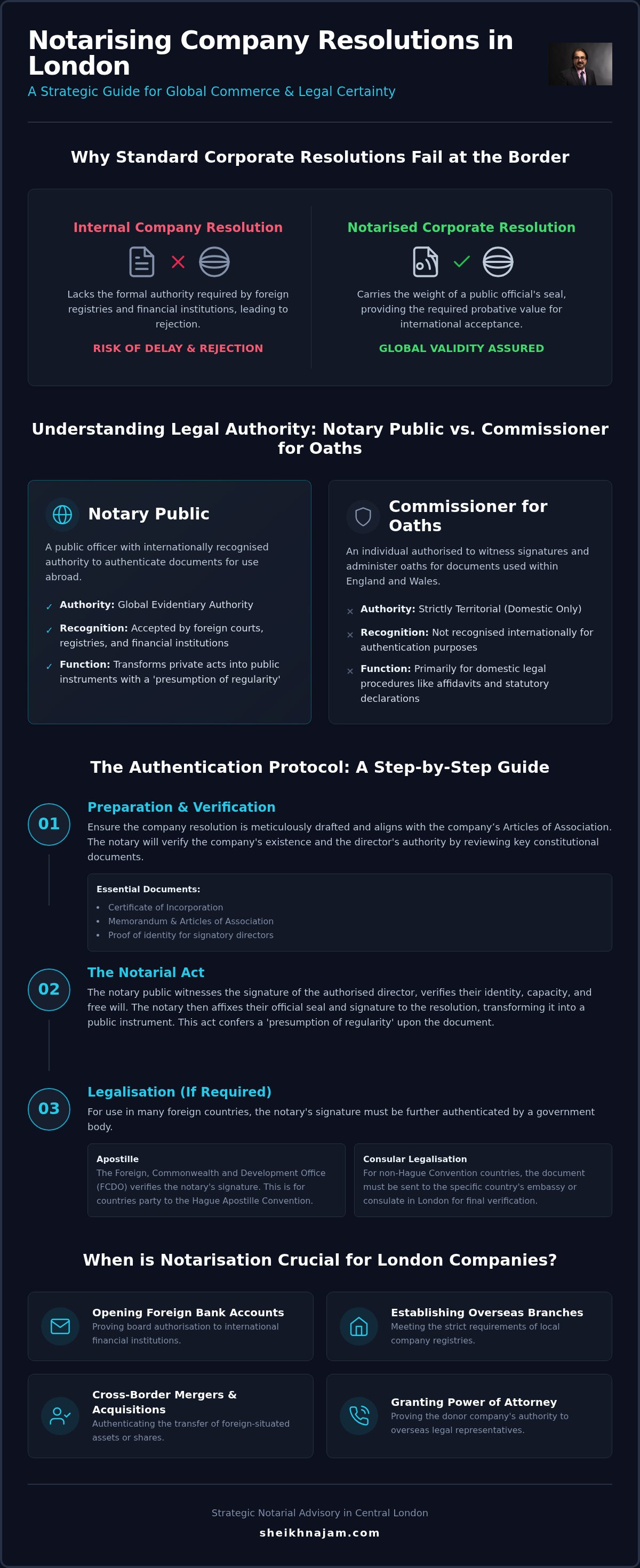
The notarial act is fundamentally characterised by its transformation of a private corporate decision into a public instrument of authentication. When a board of directors or a body of shareholders passes a resolution, the resulting document remains a purely internal record until it is subjected to the rigorous scrutiny of a qualified practitioner. For entities engaged in global commerce, notarising company resolutions London provides the necessary probative value that allows these documents to be accepted as conclusive evidence of a company's intentions and authority in foreign jurisdictions. This process ensures that the resolution is not merely a piece of paper, but a legally fortified instrument that carries the weight of a public official's seal and signature.
The role of a Notary Public extends far beyond the domestic limitations of a Commissioner for Oaths. Whilst a Commissioner for Oaths serves a vital function within the domestic legal framework of England and Wales, their authority is strictly territorial and lacks the international recognition afforded to the notarial profession. Foreign registries, government departments, and financial institutions rely on the principle of international comity, where the official acts of a London notary are respected as valid exercises of state-authorised power. This global authority is why a notary's seal is indispensable for documents destined for civil law jurisdictions, where the notary occupies a central role in the legal architecture.
In the context of international commercial arbitration and high-stakes litigation, notarised resolutions serve as vital evidence that can prevent procedural challenges regarding corporate capacity. A properly authenticated resolution is often considered self-authenticating in many legal systems, which significantly reduces the burden of proof required to establish that a company was legally bound by a specific decision. This evidentiary certainty is a cornerstone of strategic risk management for London-based firms operating across multiple borders.
Understanding the Evidentiary Weight of a Notarial Seal
Documents authenticated by a notary benefit from a "presumption of regularity," meaning that a court or registry will assume the document was executed correctly unless compelling evidence proves otherwise. The notary's duty is not limited to the mere verification of an identity; it encompasses a rigorous assessment of the signatory's capacity and their free will to enter into the transaction. This ensures that the resolution reflects a genuine, authorised corporate act. Additionally, the notary's statutory record-keeping duties provide a permanent protocol that can be accessed during future corporate audits or legal disputes, offering a layer of security that simple witness signatures cannot provide.
When Does a London Company Require Notarised Resolutions?
The requirement for formal notarisation typically arises during critical phases of international expansion or structural change. Common scenarios include:
The opening of corporate bank accounts in foreign financial centres that require proof of board authorisation.
The establishment of overseas branches or subsidiary entities where local registries demand authenticated constitutional documents.
The execution of cross-border mergers and acquisitions involving the transfer of foreign-situated assets or shares.
The granting of a Power of Attorney to overseas legal representatives, which must be backed by a notarised board resolution to prove the donor's authority.
By ensuring that notarising company resolutions London is handled with the necessary academic rigour, companies can avoid the administrative paralysis that often accompanies improperly executed international documentation.
Preparing Company Resolutions for Notarial Authentication
The legal efficacy of a corporate resolution is inextricably linked to its constitutional validity within the framework of the company's Articles of Association. When notarising company resolutions London, the practitioner's primary duty is to ensure the resolution doesn't ultra vires the company's powers, as any act exceeding these boundaries remains void and unenforceable. A sophisticated notary doesn't merely witness a signature; they perform a meticulous audit of the corporate authority, requiring the submission of original minutes or certified extracts of the meeting for comprehensive inspection. This verification process confirms that the resolution was passed in accordance with the prescribed internal governance procedures, providing the recipient with absolute legal certainty.
Precision in drafting is paramount, particularly regarding the identification of authorised signatories, often referred to in international contexts as "attorneys-in-fact." The resolution must explicitly name these individuals and define the scope of their authority to prevent any ambiguity that foreign registries might exploit to reject the document. For resolutions intended for civil law jurisdictions, the language often requires a more prescriptive and formal structure than those used in common law territories. This meticulousness ensures that the document possesses the necessary "probative value" to function as a public instrument once the notarial seal is affixed.
Board Resolutions vs. Shareholder Resolutions
A significant gap in standard legal guidance involves the distinct procedural requirements for authenticating board resolutions versus shareholder resolutions for international use. The notary must verify the specific quorum requirements and the voting process as dictated by the company's constitution. Under the Companies Act 2006, written resolutions possess specific procedural nuances that must be satisfied before authentication can occur. The practitioner confirms the validity of the meeting or the written process by reviewing the statutory registers, ensuring that the corporate action isn't subject to future challenge by dissenting shareholders or regulatory bodies.
Drafting for Multi-Jurisdictional Validity
Drafting resolutions for use in non-English speaking countries frequently necessitates the incorporation of bilingual text within the same instrument. This dual-language approach ensures that both the London notary and the foreign recipient can verify the content without the need for secondary translations that might introduce linguistic discrepancies. Furthermore, the resolution must address any "mandatory rules" or specific local requirements of the recipient jurisdiction, such as specific witness counts or the inclusion of certain statutory declarations. For businesses managing complex successions or cross-border asset transfers, these considerations often intersect with international wills London to ensure corporate continuity across jurisdictions.
Engaging a practitioner who understands these intricate multi-disciplinary intersections ensures that your corporate instruments are resilient against foreign legal challenges; those seeking such meticulous oversight may find it beneficial to consult with a specialist in notarial services.
The Notarisation Process: A Step-by-Step Protocol for London Firms
The process of notarising company resolutions London begins not with the application of a seal, but with a rigorous jurisdictional analysis. Each sovereign state maintains idiosyncratic requirements for the authentication of corporate instruments, necessitating an initial consultation to define the specific expectations of the recipient registry or financial institution. This strategic assessment determines whether the resolution requires a simple notarial certificate or the more complex "public form" document often demanded by civil law jurisdictions in Europe and South America. Without this foundational clarity, even a perfectly executed document may face rejection upon arrival in the target country.
Following the initial assessment, the entity must submit its primary constitutional documents for inspection, including the Memorandum and Articles of Association and the Certificate of Incorporation. The practitioner does not rely solely on client-provided copies; they conduct an independent search of the Companies House register to verify the current standing of the company and ensure that no winding-up petitions or strike-off notices are active. This meticulous verification provides the evidentiary foundation for the "presumption of regularity" that foreign courts expect from a London-based notary. The process culminates in the physical execution of the document, where the signatories must appear before the notary to perform their official act.
Establishing Corporate Power and Authority
A sophisticated notarial protocol involves a dual-layered verification of authority that goes far beyond simple identity checking. The "Constitutional Check" serves to prove that the company possesses the inherent power under its Articles to pass the specific resolution in question. Simultaneously, the "Authorisation Check" verifies the appointment and current standing of the directors or secretaries intended to execute the instrument. By reviewing the internal Register of Members and the Register of Directors, the notary confirms the corporate hierarchy and ensures the action is immune to future challenges regarding a lack of authority. This level of scrutiny is essential for notarising company resolutions London when the documents are destined for high-stakes international environments.
The Execution of Documents and Verification of Signatures
The physical execution of the resolution remains the definitive standard for international commerce, typically requiring signatories to appear in person before the London notary. Whilst the UK is navigating an emerging landscape of e-notarisation and digital signatures, many foreign jurisdictions still mandate "wet ink" signatures and an embossed physical seal for corporate instruments to be deemed valid. The notary's role during this meeting is to ensure the signatories fully comprehend the legal implications and obligations created by the resolution they're signing. This professional oversight is a critical component of the notary public for company documents, providing the necessary assurance that the corporate act was performed with full capacity and intent.
Navigating Legalisation: Apostilles and Consular Authentication
Once the professional act of notarising company resolutions London is concluded, the resulting instrument often requires a subsequent layer of state verification to achieve full recognition within a foreign legal system. This process, known as legalisation, serves as the sovereign confirmation of the notary's signature and seal, effectively transforming a professionally authenticated document into a globally recognised public instrument. In the United Kingdom, this authority is exclusively vested in the Foreign, Commonwealth and Development Office (FCDO). For London-based entities, the transition from the notary's chambers to the legalisation office is a critical juncture where administrative precision is paramount to avoid the summary rejection of high-value commercial documents by overseas registries or financial institutions.
The FCDO maintains a comprehensive registry of all authorised notarial signatures and seals, allowing officials to verify the provenance of the document before affixing the necessary government certification. Depending on the urgency of the corporate matter, firms may choose between standard and premium legalisation services, the latter being essential for time-sensitive cross-border mergers or acquisitions. As of March 2026, the standard paper-based apostille fee is £45, whilst the e-Apostille is priced at £35. Navigating these workflows requires a meticulous understanding of the FCDO's technical requirements, ensuring that the notary's signature is currently recognised and correctly formatted for the specific receiving jurisdiction.
The Hague Apostille Convention and London’s Foreign Office
For jurisdictions that are signatories to the Hague Apostille Convention, the process is streamlined through the issuance of a single certificate known as an Apostille. This international treaty allows a document authenticated in London to be accepted in member states without the need for further intervention from the recipient country's embassy. The technical requirements for a notary's signature to be recognised by the FCDO are stringent, necessitating that the practitioner is in good standing with the Court of Faculties. Strategic timing is vital; managing the workflow between the initial act of notarising company resolutions London and the subsequent FCDO submission ensures that the evidentiary chain remains unbroken and the transaction's momentum is maintained.
Dealing with Non-Convention Jurisdictions
Entities operating in jurisdictions that haven't ratified the Hague Convention, such as the United Arab Emirates or China, must navigate the more complex "double legalisation" protocol. This involves first obtaining an Apostille from the FCDO, followed by a secondary ratification from the consular section of the relevant foreign embassy in London. These non-convention jurisdictions often impose idiosyncratic requirements, including specific translations or Chamber of Commerce certifications, which can significantly increase the administrative burden. For instance, consular fees in certain jurisdictions have historically reached as high as £500 per document. Professional advisory is indispensable here to ensure that the document satisfies the diverse international standards of emerging markets. To ensure your corporate instruments meet these rigorous global demands, you should consult a specialist in notarial services to secure absolute compliance.
Strategic Notarial Advisory by Sheikh Najam TEP in Central London
The practice of Sheikh Najam TEP, situated in the financial heart of Central London, operates at the sophisticated intersection of international law, tax, and corporate governance. When notarising company resolutions London, the practitioner does not view the task as an isolated administrative requirement; rather, it is treated as a strategic component of a company's global compliance architecture. By harmonising notarial acts with a broader suite of notarial services, the practice provides an elite level of oversight that protects the interests of high-net-worth individuals and their private corporate vehicles. The specific advantage of engaging an advisor who possesses deep mastery in international tax planning for business owners London is that the long-term fiscal and regulatory consequences of every resolution are analysed before the seal is ever applied.
This multi-disciplinary approach ensures that every resolution notarised contributes to the firm's long-term regulatory health. Rather than offering a standard transactional service, the practice provides a bespoke advisory that anticipates the requirements of foreign registries and financial institutions. By aligning corporate decisions with international standards of transparency and reporting, London-based entities can navigate cross-border commerce with the certainty that their foundational legal instruments are resilient against jurisdictional challenges.
Bespoke Authentication for High-Value Transactions
The authentication of resolutions for multi-layered corporate structures, family offices, and complex trusts requires a level of academic rigour that standard providers often fail to deliver. The "Scholar-Practitioner" approach ensures that every instrument is examined through a multi-disciplinary lens, verifying that the corporate action remains consistent with the entity's global fiduciary duties. Absolute discretion and security are the hallmarks of this practice, providing elite London clients with the reassurance that their most sensitive corporate affairs are handled with meticulous precision. This bespoke service is particularly vital during high-stakes transactions where the validity of a single board resolution can dictate the success of a multi-million-pound acquisition.
Integrating Notarial Services with Global Compliance
In an era of increasing transparency, the act of notarisation must be integrated with robust Anti-Money Laundering (AML) and Know Your Customer (KYC) protocols. Sheikh Najam TEP ensures that the process of notarising company resolutions London supports the firm's broader financial crime risk assessments, providing foreign regulators and banks with the necessary confidence in the entity's legitimacy. By verifying the identity and authority of signatories within this rigorous framework, the practice mitigates the risk of future regulatory challenges or institutional rejection. For entities seeking a command-and-control approach to their international legal documentation, the path forward is clear. Consult with Sheikh Najam TEP for professional notarial services to secure the strategic authentication required for your global commercial operations.
Securing Global Corporate Efficacy Through Strategic Authentication
The path to successful international commerce requires more than simple administrative compliance; it demands a rigorous verification of corporate authority that can withstand the scrutiny of foreign registries and sovereign courts. By meticulously notarising company resolutions London, entities ensure their board decisions possess the necessary probative weight to facilitate complex cross-border transactions and high-value mergers. We've explored the critical importance of aligning resolutions with constitutional documents and the subsequent necessity of navigating the FCDO legalisation framework with absolute precision.
This strategic authentication serves as a vital safeguard against jurisdictional delays and regulatory challenges. Sheikh Najam TEP, appointed by the Court of Faculties of the Archbishop of Canterbury, provides a Central London practice that combines elite notarial services with deep expertise in international tax and trust law. This multi-disciplinary approach guarantees that your corporate instruments aren't just witnessed, but strategically fortified for global use. Don't leave your international affairs to chance. Instruct Sheikh Najam TEP for Expert Corporate Notarisation in London and ensure your business operates with the highest level of legal certainty.
Frequently Asked Questions
Why is notarisation required for company resolutions intended for use abroad?
Notarisation is essential because foreign registries and financial institutions lack the jurisdiction to verify the internal records of a UK entity. By subjecting a resolution to notarial authentication, the document is transformed into a public instrument that carries a presumption of regularity under international law. This process provides the necessary evidentiary weight required for the document to be accepted as conclusive proof of corporate authority within sovereign legal systems outside the United Kingdom.
How long does it take to notarise a company resolution in London?
The timeframe for notarising company resolutions London depends largely on the complexity of the underlying corporate structure and the subsequent legalisation requirements. Whilst the act of notarisation itself can often be completed within twenty four to forty eight hours of receiving all necessary constitutional documents, the addition of an FCDO Apostille or consular legalisation may extend the process. Entities should account for current FCDO processing times, which vary based on the selection of standard or premium services.
What evidence of authority must a director provide to the notary?
Directors must present comprehensive evidence of their identity and their specific legal capacity to bind the company. This typically involves providing valid photographic identification alongside the company’s statutory registers and current Articles of Association. The notary performs an independent verification via Companies House to confirm the director’s appointment and ensures the resolution doesn't exceed the powers granted by the company’s constitution. This dual layered check is fundamental to establishing absolute corporate authority for international recipients.
Can a company resolution be notarised remotely or via video link in the UK?
Whilst digital transformation is influencing the legal landscape, most foreign jurisdictions still mandate the physical presence of signatories before a notary for corporate instruments. Remote notarisation via video link often fails to satisfy the rigorous evidentiary standards of civil law countries or international banks. Consequently, the gold standard remains the in person execution of the document, where the notary can personally attest to the signatory’s identity, capacity, and understanding of the resolution’s legal implications.
What is the difference between a notary public and a solicitor for corporate documents?
A solicitor is a legal practitioner whose authority is primarily domestic and territorial within England and Wales. In contrast, a Notary Public is a public officer whose seal and signature are recognised globally under the principle of international comity. Whilst a solicitor may certify a document for use within the UK, only a notary can authenticate a corporate resolution as a public instrument that possesses the evidentiary weight required by foreign government registries and overseas financial institutions.
Do I always need an Apostille after my resolution has been notarised?
The requirement for an Apostille is dictated by the recipient jurisdiction’s participation in the Hague Apostille Convention. If the destination country is a signatory, an Apostille from the Foreign, Commonwealth and Development Office is usually the final step of legalisation. However, for non convention countries, a further layer of consular authentication is required. It's imperative to confirm these specific requirements during the initial consultation to ensure the notarised resolution achieves full legal efficacy abroad.
How much does it cost to notarise a company resolution in Central London?
Professional fees for notarising company resolutions London are typically determined by the complexity of the corporate structure and the time required for meticulous verification. Most practices apply an hourly rate for bespoke advisory or a per document fee for the authentication of resolutions and constitutional extracts. Additional disbursements, such as FCDO legalisation fees and consular charges, are also factored into the total expenditure. Clients should request a tailored fee proposal based on their specific multi jurisdictional requirements.
What happens if a resolution is not properly notarised for an international transaction?
Improperly authenticated resolutions often lead to the summary rejection of the document by foreign registries, resulting in catastrophic delays for international transactions. This failure can jeopardise high value mergers, lead to breaches of contractual timelines, and incur significant additional legal costs. Without a valid notarial seal, the resolution lacks the necessary probative value to prove corporate authority, potentially exposing the entity to litigation or the inability to access foreign situated assets and financial accounts.


Comments